049 Taste Bud Boot Camp: Training Your Palate to Love Whole Foods
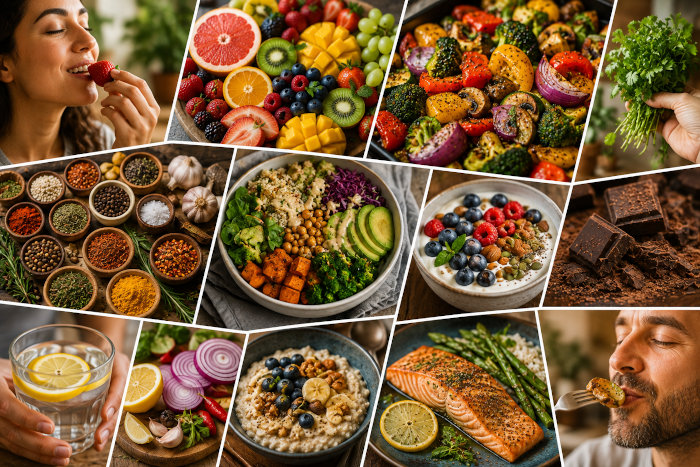
How repeated exposure, hunger, preparation, expectations, and reducing added sugar can change the way healthy food tastes.
Growing up, there was a simple rule at our dinner table:
Try each food. Even a small amount is fine. You may find out you like it.
It was surprisingly good advice.
There certainly were foods I didn't like. But I tried them. And something interesting happened over the years: more often than not, foods I originally didn't care for eventually became foods I enjoyed.
Sports added another influence. Being competitive made me interested in being healthy and performing well. If I learned that a particular food was good for me, that knowledge actually made me more interested in eating it.
Maybe I didn't love it immediately.
But I would think:
This is good for me. There must be a way I can learn to like it.
Decades later, I enjoy an enormous variety of whole foods.
So here's an interesting question:
Can we actually train ourselves to enjoy healthier food?
The answer appears to be yes — at least to a meaningful degree.
Taste Isn't Set in Stone
We sometimes talk about food preferences as though they are permanent personality traits.
"I don't like vegetables."
"I hate fish."
"I don't eat beans."
"I don't like anything bitter."
But our food preferences are influenced by far more than the chemical receptors on our tongues.
What we call flavor is constructed from a combination of:
- Taste
- Smell
- Texture
- Temperature
- Appearance
- Previous experiences
- Expectations
- Memories
- Hunger
- Culture
- Context
In other words, we don't simply taste food with our tongues.
We experience food with our brains.
Do Your Taste Buds Really Replace Themselves?
You may have heard that your taste buds completely replace themselves every 30 days.
There is some truth hiding inside that popular explanation, but the biology is more interesting.
Taste buds contain specialized taste-receptor cells, and many of those cells have relatively short lifespans. Different types of taste cells turn over at different rates, often on the scale of days to a few weeks.
New cells continually replace older ones.
But this does not mean that every month we wake up with brand-new taste buds and suddenly have an opportunity to reset everything we like.
Changing food preferences involves much more than cellular replacement.
The brain learns.
Smells become familiar.
Textures become familiar.
Expectations change.
And repeated exposure can change our reaction to foods we once rejected.
Mom May Have Been Onto Something
"Try a little."
That may be one of the best strategies for expanding a healthy diet.
The important part is a little.
If someone strongly dislikes broccoli, forcing them to eat an enormous serving probably isn't going to create a lifelong broccoli enthusiast.
But a bite?
That's different.
Repeated exposure allows an unfamiliar flavor to become familiar without turning dinner into a battle.
This principle is particularly important with children, but adults can use it too.
You don't have to love a food today.
You can simply remain willing to experience it again.
Maybe You Don't Dislike the Food
Here's another possibility:
Maybe you don't dislike broccoli. Maybe you dislike boiled broccoli.
Preparation can completely change a food.
Consider Brussels sprouts.
Boiled until soft, they have one flavor and texture.
Cut in half, lightly coated with olive oil, seasoned, and roasted until the edges caramelize?
That's practically a different food experience.
The same principle applies throughout the whole-food world.
- Raw vegetables versus roasted vegetables
- Fresh tomatoes versus cooked tomatoes
- Plain oatmeal versus oatmeal with berries, walnuts, and cinnamon
- Plain beans versus beans seasoned with herbs, onions, garlic, and spices
- Raw cabbage versus fermented sauerkraut
- Steamed fish versus grilled fish
Before deciding you dislike a healthy food, try asking:
Have I actually tried enough versions of it?
The Three-Way Rule
Instead of trying a healthy food once and declaring it permanently unacceptable, consider a simple experiment.
Try it three different ways.
Prepare it differently.
Season it differently.
Combine it with different whole foods.
And try those versions on different occasions.
You may still dislike it.
That's okay!
Healthy eating doesn't require loving every healthy food on Earth.
The goal is to discover enough healthy foods that you genuinely enjoy that eating well doesn't feel like punishment.
Knowing a Food Is Healthy Can Change the Experience
This is another fascinating part of taste.
Our expectations influence our experiences.
If you're an athlete and learn that a particular food provides protein, minerals, fiber, antioxidants, or useful carbohydrates, suddenly that food has another meaning.
You're no longer thinking only:
"What does this taste like?"
You may also be thinking:
"What can this do for my body?"
That doesn't magically change the chemical composition of the food.
But it can change your willingness to eat it, experiment with it, prepare it differently, and give yourself enough repeated exposures to acquire the taste.
Healthy food becomes something you want to figure out.
Then There Is Hunger
There is another remarkable seasoning that doesn't come from the spice rack.
Hunger.
Think about spending an entire day outdoors.
Maybe you're hiking for hours.
Maybe you're fishing all day with only a small snack.
Maybe you're doing hard physical work and had only a modest lunch.
Then you finally sit down for supper.
Suddenly...
Everything tastes fantastic.
There is biology behind this experience.
Hunger Changes the Brain's Interest in Food
Hunger isn't simply an empty stomach.
The body continuously monitors energy availability through an elaborate network involving hormones, nerves, the digestive system, and the brain.
When energy is needed, hunger-related signals increase the motivational value of food.
The brain essentially starts saying:
Food matters right now.
Aromas become interesting.
The sight of food becomes more rewarding.
And ordinary foods may suddenly become remarkably satisfying.
This is an important distinction between hunger and appetite.
Appetite can occur because food is sitting in front of us.
We can eat because we're bored.
We can eat because we're watching television.
We can eat because someone brought cookies into the room.
We can eat because the clock says noon.
Genuine physical hunger is different.
After spending hours hiking, working, fishing, gardening, or exercising, the body may have a very good reason to make supper look wonderful.
Should We Starve Ourselves So Broccoli Tastes Better?
No!
The lesson isn't to deliberately deprive yourself of adequate nutrition.
The more useful observation is that, for many healthy people, it isn't necessary to constantly graze throughout the day simply because food is available.
Experiencing normal hunger before a meal can be part of a healthy relationship with food.
And arriving at supper genuinely hungry may make a plate of ordinary whole foods remarkably satisfying.
One of the World's Best Seasonings Is a Day Outdoors
There is something else going on after a day of hiking, fishing, working, or exercising.
You've earned the meal psychologically as well as metabolically.
You sit down tired and hungry.
The aromas hit you.
You aren't comparing dinner with a bag of chips you ate 45 minutes earlier.
Your body wants nourishment.
Suddenly potatoes taste incredible.
Vegetables taste wonderful.
Protein is satisfying.
Fruit tastes almost like dessert.
Perhaps modern life occasionally gives us too much access to flavor without enough opportunity to experience hunger.
And Then There Was Grapefruit...
As a child, I used to put sugar on foods.
Even grapefruit.
Then one day I thought about what I was doing.
Why am I adding all this sugar?
I decided it probably wasn't something I needed.
So I stopped.
At first, grapefruit without added sugar obviously wasn't as sweet as grapefruit covered with sugar.
But something interesting happened over time.
I learned to enjoy grapefruit by itself.
Today, grapefruit tastes remarkably sweet and flavorful to me exactly as it is.
The Grapefruit Didn't Get Sweeter
This may be one of the most important lessons in Taste Bud Boot Camp.
The grapefruit didn't change.
I did.
When we routinely consume foods with large amounts of added sugar, intensely sweet flavors can become our reference point.
Foods containing their own natural sugars may seem less exciting by comparison.
Reduce the added sweetness and something interesting can happen.
The subtler sweetness already present in whole foods becomes much easier to appreciate.
Fruit begins tasting extraordinarily sweet.
Carrots have sweetness.
Tomatoes have sweetness.
Nuts have complex flavors.
Even vegetables that once seemed boring begin revealing flavors we may not have noticed before.
We Can Change Our Sweetness Benchmark
Imagine someone who puts three teaspoons of sugar in every cup of tea.
Remove all three tomorrow and the tea may taste unpleasant.
But what if the amount gradually becomes:
Three teaspoons...
Then two and a half...
Then two...
Then one...
Then half...
Then none?
Eventually something surprising may happen.
Go back and taste the original version.
It may now taste far too sweet.
The recipe didn't change.
Your expectations did.
Whole Foods Have Subtle Flavors
Many highly processed foods are deliberately designed to deliver powerful sensory experiences.
They may combine concentrated amounts of:
- Sugar
- Salt
- Fat
- Flavorings
- Crunch
- Acidity
- Aromas
Put a plain blueberry next to an intensely sweet candy and the blueberry may seem mild.
But reduce the intensely flavored foods for a while and eat that blueberry when you're genuinely hungry.
Suddenly it can taste incredibly sweet.
Whole foods weren't necessarily bland. We may simply have trained ourselves to expect sensory amplification.
Can You Retrain Your Palate?
Yes — although "training your brain and palate" is probably more accurate than simply "training your taste buds."
The process doesn't need to be complicated.
1. Keep Trying
Don't let one experience permanently define a food.
2. Keep the Portion Small
A bite is enough for an experiment.
3. Change the Preparation
Roast it. Grill it. Steam it. Ferment it. Season it. Combine it with another whole food.
4. Reduce Added Sugar Gradually
Give your perception of sweetness time to adapt.
5. Do the Same With Excessive Salt
Herbs, spices, garlic, onions, citrus, vinegar, and fermentation can provide enormous flavor without simply making everything saltier.
6. Use Herbs and Spices
Healthy eating does not mean flavorless eating.
Quite the opposite.
7. Let Yourself Become Reasonably Hungry
For healthy individuals, constantly eating isn't necessarily required. A genuine appetite can make ordinary whole foods surprisingly satisfying.
8. Eat After Activity
A walk, workout, afternoon gardening, or day outdoors can completely change your relationship with the meal that follows.
9. Remember Why You're Eating It
Knowing that a food contributes protein, fiber, vitamins, minerals, healthy fats, or useful plant compounds can make learning to enjoy it feel worthwhile.
10. Don't Force Yourself to Love Everything
You are still allowed to dislike foods!
The objective isn't to convince yourself that every vegetable tastes wonderful.
The objective is to avoid unnecessarily limiting yourself because of a conclusion you made after tasting something once 30 years ago.
A Taste Bud Boot Camp Experiment
Choose one healthy whole food that you currently don't particularly like.
Don't eat a giant bowl of it.
Experiment with it.
Try it prepared three different ways over several weeks.
Use different herbs or spices.
Try a small serving when you're genuinely hungry.
Combine it with healthy foods you already enjoy.
Then ask yourself:
Do I actually dislike this food as much as I thought?
You might.
Or you might discover something new.
The Goal Isn't a Perfect Diet
The goal of healthy eating shouldn't be creating a list of foods we're forced to consume because someone told us they're good for us.
A much better long-term goal may be:
Develop a palate that genuinely enjoys healthy food.
Once that happens, something powerful changes.
You aren't continually using willpower to choose the "healthy option."
The healthy option may actually be what you want.
Fruit tastes sweet.
Vegetables have interesting flavors.
Whole grains have texture.
Nuts taste rich.
Fermented foods become fascinating.
Herbs and spices open an enormous world of flavor.
And a meal after an active day can taste better than almost anything.
Mom's Rule Was Pretty Good
After looking at taste biology, repeated exposure, hunger, sensory adaptation, learning, expectations, and the psychology of food, we can return to one remarkably simple piece of advice:
Try a little. You may find out you like it.
If you don't?
That's fine.
Try it another way sometime.
And if you're still not convinced...
Maybe try it after you've been hiking all day.
Everything seems to taste better then!
The Grapefruit Lesson
Perhaps the grapefruit provides the simplest summary of Taste Bud Boot Camp.
I once thought grapefruit needed sugar.
Then I stopped adding it.
Eventually I discovered how sweet, complex, and flavorful grapefruit already was.
The grapefruit never got sweeter.
I learned to taste the grapefruit.
Zehr.ws Health Perspective: Healthy eating isn't about perfection, forcing yourself to eat foods you hate, or following a single prescribed diet. Individual nutritional needs and medical circumstances vary. This article explores how taste, food preferences, preparation, activity, hunger, and repeated exposure may influence our enjoyment of whole foods. People with diabetes, eating disorders, metabolic conditions, medication-related dietary requirements, or other medical concerns should follow appropriate professional guidance rather than deliberately changing meal timing or restricting food intake.

Exploring Health, Longevity, and Better Living
Zehr.ws