050 Stretching Boot Camp: Staying Flexible, Mobile, and Ready to Move
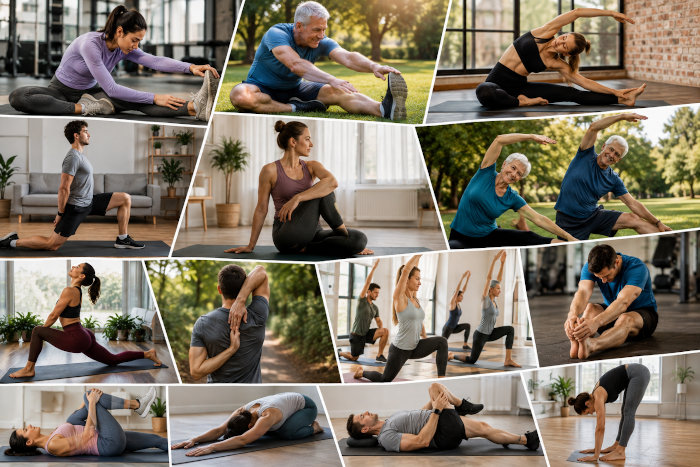
What sports, dance, aging, and modern exercise science can teach us about maintaining range of motion for a lifetime.
When I was young and involved in sports, I learned that stretching was important.
Then I became involved in dance.
Suddenly stretching wasn't just something you did for a few minutes before practice. Flexibility was part of the training.
One Friday afternoon each week, an hour-long stretching class was offered. I started attending.
At first, it was hard.
Some positions were uncomfortable. My flexibility wasn't particularly impressive. But I kept going.
And something began to happen.
I got better.
Not overnight. Not after one miraculous stretching session.
Little by little, my body adapted.
Eventually I became quite good at it — sometimes even leading the stretching workout.
The following year, several football players began attending the class. I had played football with some of them a couple of years earlier.
I could hear them talking:
"How did Zehr get so good at this?"
I knew exactly how they felt because I remembered when those same stretches had been difficult for me.
My advice was simple:
Stick with it. You will improve.
That may be the first lesson of Stretching Boot Camp.
Flexibility is trainable.
What Exactly Happens When We Stretch?
Stretching seems simple.
Move into a position.
Feel tension.
Hold it.
But underneath that simple movement is an interaction between muscles, tendons, connective tissues, joints, sensory receptors, nerves, and the brain.
Your nervous system is continually monitoring how far a joint is moving and how much tension is being placed on tissues.
When you first begin flexibility training, your nervous system may interpret a particular position as:
"That's far enough."
With repeated, progressive stretching, the body can become more tolerant of those positions.
Longer-term flexibility training may also produce changes within the muscle-tendon system itself.
This helps explain why a stretch that initially seems nearly impossible can eventually become comfortable.
Flexibility Versus Mobility
These words are sometimes used interchangeably, but there is a useful distinction.
Flexibility generally describes the available range of motion around a joint.
Mobility involves being able to actively move through and control that range.
Imagine being able to use your hands to pull your leg into a particular position.
That's flexibility.
Now imagine lifting and controlling the leg through much of that same range using your own muscles.
That's mobility.
For healthy living and healthy aging, we probably want both.
Range of motion is useful. Being able to control that range is even better.
Dance Taught a Different Kind of Stretching
Sports had taught me that stretching mattered.
Dance showed me how much it could be developed.
Dancers don't simply stretch for a few minutes because someone told them they should.
Movement through large ranges of motion is fundamental to what they do.
Dance also combines:
- Flexibility
- Strength
- Balance
- Coordination
- Body awareness
- Posture
- Timing
- Control through large ranges of motion
That combination may be particularly important.
We don't necessarily want flexibility without control.
We want a body capable of moving freely and controlling that movement.
Something Else Happened
As my flexibility and movement improved, I noticed something I hadn't necessarily expected.
I felt quicker and faster.
I also felt that problems remaining from earlier sports injuries gradually disappeared.
That doesn't prove that stretching alone caused either result.
Dance training was simultaneously improving balance, coordination, movement skill, strength, and body awareness.
But it raised an interesting question:
How well can an athlete move if parts of the body are unnecessarily restricted?
If the hips, ankles, shoulders, or other joints don't comfortably move through the ranges required by a sport, the body may have to compensate somewhere else.
Restoring useful movement can therefore be an important part of athletic training and rehabilitation.
Can Stretching Heal Old Injuries?
This requires an important distinction.
Stretching isn't a universal treatment for injuries.
Some injuries require rest, progressive strengthening, physical therapy, medical evaluation, or other treatment.
Stretching an injured structure aggressively can sometimes make matters worse.
However, after an injury has healed, reduced range of motion can sometimes remain.
Muscles may become tight.
Movement patterns may change.
A person may unconsciously protect an area long after the original injury.
In appropriate situations, progressively restoring normal range of motion can be one component of returning the body to normal movement.
The important lesson isn't:
"Stretch every injury."
It is:
"Don't automatically accept permanent stiffness as the inevitable result of an old injury."
Stretching and Injury Prevention
For decades, athletes were often told:
"Stretch before you play so you don't get injured."
Modern research has made that statement much more complicated.
Stretching by itself isn't a magic shield against injury.
Injury risk involves many factors, including:
- Strength
- Fatigue
- Training load
- Previous injuries
- Movement mechanics
- Conditioning
- Warm-up
- Sport-specific demands
- Recovery
- Range of motion
Maintaining appropriate flexibility may be one useful piece of the puzzle, especially when a sport requires significant ranges of motion.
But stretching shouldn't replace strength training, conditioning, good technique, or sensible progression.
Stretching and Warming Up Are Not the Same Thing
This is one of the most useful lessons from modern exercise science.
A warm-up prepares the body to perform.
A stretching session may be designed primarily to increase flexibility.
Those aren't necessarily the same objective.
Before running, jumping, throwing, or performing explosive movements, the goal is generally to gradually prepare the body for the activity that is coming.
That usually means movement.
Dynamic Stretching Before Activity
Dynamic stretching involves actively moving joints through comfortable ranges of motion rather than simply moving into a position and holding it.
Examples might include:
- Arm circles
- Leg swings
- Walking lunges
- Hip rotations
- Controlled trunk rotations
- High-knee movements
- Progressively faster walking or jogging
Then the movements can become increasingly specific to the activity you're about to perform.
A softball player might gradually begin throwing.
A runner might progressively increase running speed.
A tennis player might practice increasingly vigorous swings.
The message to the body is:
"This is what we're about to do. Get ready."
Static Stretching
Static stretching is what most people traditionally picture when they hear the word stretching.
You gradually move into a position until you feel tension and then hold that position.
Static stretching can be very effective for improving flexibility.
But timing matters.
Research suggests that prolonged static stretching immediately before maximal strength, sprinting, jumping, or explosive activity can temporarily reduce performance, particularly when individual stretches are held for relatively long periods.
That doesn't mean static stretching is bad.
It means:
Use the right tool at the right time.
When Should We Do Longer Static Stretching?
A dedicated flexibility session can be an excellent time.
After exercise may also be comfortable for some people because the body is already warm, although stretching after exercise isn't a magical way to prevent soreness.
Another option is exactly what that Friday dance class provided:
Make flexibility training its own workout.
Instead of rushing through five minutes of stretching, occasionally spend meaningful time exploring how your body moves.
Stretching Doesn't Have to Hurt
This may be one of the biggest mistakes people make.
If some stretching is good, they assume harder stretching must be better.
Not necessarily.
A productive stretch commonly produces tension or mild discomfort.
It should not normally produce sharp pain, electrical sensations, sudden joint pain, or a feeling that something is tearing.
Stretching is progressive training, not a contest with your connective tissue.
Give the body time to adapt.
The Football Players Learned the Same Lesson
When those football players first arrived at stretching class, some movements were difficult.
They saw someone who had already been doing it and wondered how he had become so flexible.
But they were comparing their beginning with someone else's progress.
The answer wasn't special genetics or a secret technique.
It was largely:
Keep doing it.
That principle applies at almost any age.
You don't need to touch your toes today to benefit from working toward greater mobility.
You simply need an appropriate starting point.
Stretching for Athletic Longevity
Years later, I was still playing softball.
Many of my teammates were considerably younger than I was.
They sometimes commented on how much stretching I did before games — and even during games.
By then, it wasn't something I thought much about.
It was simply part of playing.
I wanted my body to remain ready to move.
I played softball for roughly 30 years.
Eventually I decided it was time to retire.
But importantly, I wasn't retiring because I could no longer play.
I was still playing well.
Our team made the playoffs, and I was determined that if I was going to finish my softball career, I wanted to go out on a win.
As the pitcher, I knew I could have a meaningful influence on whether that happened.
We won.
That seemed like a pretty good time to retire.
The Goal Changes as We Age
When we're young, stretching may be about sports performance.
Can I kick higher?
Can I run more freely?
Can I move faster?
Can I improve my dance technique?
Later in life, the questions become even more important.
Can I comfortably put on my shoes?
Can I reach overhead?
Can I turn around easily?
Can I get down onto the floor?
Can I get back up?
Can I step over something without losing my balance?
Can I work in the garden?
Can I hike?
Can I continue doing the things I enjoy?
Suddenly mobility isn't merely athletic performance.
It is independence.
Strength and Flexibility Belong Together
Healthy aging shouldn't force us to choose between being strong and being flexible.
Ideally, we want both.
Strength without sufficient mobility can limit movement.
Flexibility without strength and control may not provide the stability we need.
A useful long-term fitness program therefore includes:
- Strength
- Cardiovascular fitness
- Balance
- Coordination
- Flexibility
- Mobility
These aren't competing forms of fitness.
They support one another.
Don't Forget Balance
Mobility also interacts with balance.
Walking over uneven ground requires the ankles, knees, and hips to continually adapt.
If movement becomes severely restricted, recovering from an unexpected step or stumble may become more difficult.
But flexibility alone doesn't prevent falls.
Strength, vision, reaction time, coordination, neurological function, medications, and the environment all matter.
Once again, the lesson is not that stretching solves everything.
The lesson is that movement capacity is part of the larger system.
Stretching Can Feel Good
There is another benefit that shouldn't get lost in discussions about biomechanics.
After those long Friday stretching classes, I felt wonderful.
Relaxed.
Loose.
Comfortable.
Stretching can provide a quiet period in which we slow down and pay attention to the body.
Breathing often becomes slower and more deliberate.
We notice where we're carrying tension.
We aren't racing a clock, chasing a ball, or trying to lift another repetition.
Sometimes we're simply moving, breathing, and relaxing.
That can be valuable too.
Breathing While Stretching
People sometimes unconsciously hold their breath when a stretch becomes challenging.
Try the opposite.
Breathe normally and comfortably.
Allow yourself to relax into the position rather than fighting against it.
A stretch doesn't need to become a test of toughness.
A Simple Whole-Body Approach
You don't need to perform complicated dance stretches to maintain useful mobility.
A general routine might gently explore movement through the:
- Neck
- Shoulders
- Chest
- Upper back
- Trunk
- Hips
- Hip flexors
- Hamstrings
- Quadriceps
- Calves
- Ankles
The exact routine matters less than consistency and choosing movements appropriate for your own body.
If a joint or muscle group has a significant injury history, individual professional guidance may be worthwhile.
The "Use It or Lose It" Problem
Range of motion can gradually decline when we stop using it.
Consider how modern life can shrink our movement vocabulary.
We sit in chairs.
We drive.
We work at computers.
We walk primarily on flat floors.
We rarely squat deeply.
We rarely reach far overhead.
We rarely crawl, climb, twist, or move sideways.
The body becomes very good at doing what we repeatedly ask it to do.
Unfortunately, it can also become less capable of doing things we stop asking it to do.
Don't Wait Until You Can't Move
This may be the most important message of Stretching Boot Camp.
We shouldn't necessarily wait until we're stiff before thinking about mobility.
Maintaining movement is much easier when it remains part of normal life.
A few minutes today.
A longer session another day.
Dynamic movement before exercise.
Strength through useful ranges of motion.
Walking, hiking, dancing, gardening, sports, and simply continuing to move in different ways.
It all adds up.
Your Body Doesn't Know Your Age — It Knows What You Ask It to Do
Aging is real. Bodies change.
But chronological age doesn't tell the entire story.
A body that regularly moves through varied ranges, carries loads, walks, balances, stretches, and exercises receives very different demands from one that spends most of its time sitting.
We cannot stop aging.
But we can continue giving the body reasons to maintain its capabilities.
The Stretching Boot Camp Challenge
For the next several weeks, pay attention to your movement rather than simply asking whether you're "flexible."
Notice:
- Can you comfortably reach overhead?
- Can you rotate your upper body in both directions?
- Can your ankles move freely?
- Can you comfortably bend at the hips?
- Can you get down toward the floor?
- Can you get back up?
- Do both sides of your body move similarly?
- Are there movements you've gradually stopped doing?
Don't turn the answers into a judgment.
Turn them into information.
Then work progressively on the movements that could be better.
Stick With It
I can still picture those football players coming into the stretching class and struggling with movements that had once been difficult for me too.
They wondered how I had gotten so good at it.
There wasn't a complicated answer.
I had practiced.
And that's what I told them.
Stick with it.
You will improve.
Years later, that advice seems even more important.
The objective isn't necessarily to become extraordinarily flexible.
It isn't to perform a split.
It isn't to impress anyone with how far you can reach.
The objective is much more practical:
Keep enough range of motion, strength, balance, and control to continue doing the things you love.
Whether that's dancing, playing sports, working outdoors, hiking, gardening, playing with grandchildren, building something, or simply moving comfortably through everyday life.
Fitness isn't only about how much we can lift or how fast we can run.
Sometimes fitness is simply having a body that remains ready to move.
Zehr.ws Health Perspective: Stretching and mobility exercises should be appropriate for the individual. Mild muscular tension during stretching can be normal, but sharp pain, joint pain, numbness, tingling, or instability should not be ignored. Recent injuries, significant joint problems, surgery, neurological conditions, or persistent pain may require guidance from a physician or physical therapist. Stretching is one component of physical fitness and should complement — rather than replace — appropriate strength, cardiovascular, balance, and movement training.

Exploring Health, Longevity, and Better Living
Zehr.ws