051 Play Boot Camp: When Having Fun Was Our Exercise Program
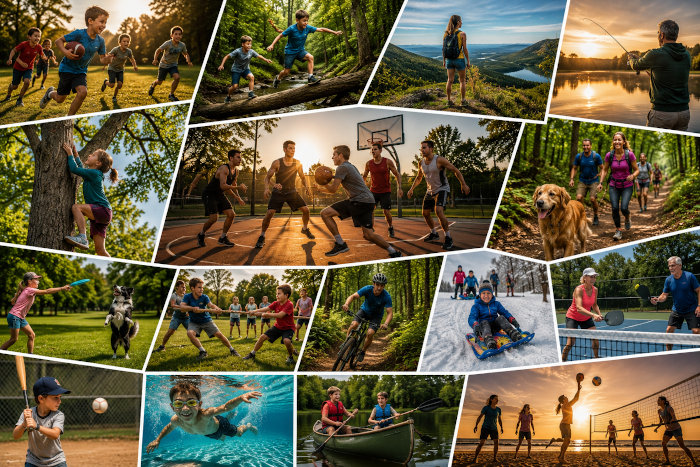
Running, climbing, throwing, exploring, competing, and setting records — perhaps some of our best physical training happened when we weren't thinking about exercise at all.
When I think back to growing up, something interesting occurs to me.
We exercised a lot.
Except we didn't call it exercise.
We were working.
We were exploring.
We were playing.
We were competing.
And quite often, we were trying to set another record.
Nobody was tracking our workout on a watch.
Nobody was telling us we needed another 20 minutes of moderate-intensity physical activity.
We simply wanted to see what we could do.
Looking back, much of that play was remarkably good physical training.
When Play Was Functional Fitness
Today we hear a lot about "functional fitness."
The basic idea is excellent: train the body to perform useful movements rather than developing fitness only in highly controlled situations.
But children have been doing functional fitness forever.
Think about ordinary outdoor play:
- Running
- Jumping
- Climbing
- Throwing
- Hitting things
- Balancing
- Carrying
- Pulling
- Pushing
- Crawling
- Changing direction
- Reacting to other people
- Moving across uneven ground
That's a remarkably complete movement program.
And the best part?
Nobody had to convince us to do it.
We Were Training Without Knowing It
Every physical activity asks the nervous system and muscles to solve problems.
Run across uneven ground and your feet and ankles constantly make tiny adjustments.
Climb something and you develop grip strength, pulling strength, balance, and judgment.
Throw a stone at a target and you're practicing coordination between the legs, hips, trunk, shoulder, arm, wrist, and eyes.
Jump over a ditch and you're estimating distance, generating force, controlling your body in the air, and preparing to land.
Carry something awkward and suddenly your entire body has to figure out how to stabilize the load.
We weren't isolating muscles.
We were solving movement problems.
Bringing the Cows Home — With Batting Practice
Growing up on a farm meant there were jobs to do.
One of those jobs was bringing the cows back to the barn.
But even a job could become play.
Along the way, I spent a lot of time hitting stones with a stick.
Pick out a stone.
Toss it.
Swing.
Try to hit it.
Do it again.
At the time, I certainly wasn't thinking:
"I'm performing visual-motor training to improve future athletic performance."
I was having fun.
Years later, however, batting became one of my strengths in softball.
I loved hitting and generally batted near the top of the lineup.
Looking back, I have to wonder how much all those years of hitting little stones contributed to my hand-eye coordination.
A Baseball Is Pretty Big Compared With a Stone
Think about the challenge.
A small stone tossed into the air isn't necessarily traveling perfectly.
It may rotate.
Its shape is irregular.
The target is small.
You have only a fraction of a second to coordinate the swing.
Do that thousands of times because it's entertaining and you have accumulated an enormous amount of practice.
Then someone throws you a softball.
Suddenly the target looks pretty good!
This is one of the wonderful things about play.
Repetition doesn't necessarily feel repetitive when you're having fun.
Throwing Stones Was Training Too
There was plenty of stone throwing as well.
Sometimes you threw for distance.
Sometimes you threw at a target.
Sometimes you simply wanted to see what you could hit.
Again, nobody called it training.
But throwing is a remarkably sophisticated whole-body movement.
A powerful throw doesn't begin at the hand.
Force moves through a chain:
Ground → legs → hips → trunk → shoulder → arm → wrist → fingers.
Years later, throwing was useful in sports including football and softball.
Was childhood stone throwing the only reason?
Of course not.
But thousands of playful throws certainly provided plenty of opportunities for the nervous system to practice coordinated throwing.
The Brain Was Training Too
Physical play isn't merely muscular exercise.
The brain is constantly calculating.
How fast is that object moving?
Where is it going?
How hard should I throw?
Can I jump that far?
Where should my foot land?
Can I climb that?
How do I keep my balance?
Where is the other player going?
Can I react quickly enough?
Much of this happens without conscious calculation.
The nervous system learns by doing.
Coordination Is a Form of Fitness
When people discuss fitness, we often focus on a few measurements:
- Strength
- Endurance
- Body weight
- Running speed
- Heart rate
Those things matter.
But there are other physical abilities worth preserving:
- Coordination
- Balance
- Reaction time
- Agility
- Spatial awareness
- Timing
- Accuracy
- Body control
Play can challenge many of these simultaneously.
Then There Was Competition
We also liked records.
How far?
How fast?
How many?
How high?
Can we beat what we did yesterday?
Can we beat each other?
Can we set a new record?
Today we might call this:
Performance tracking and progressive overload.
Back then we called it fun.
Why Records Made Us Better
Trying to beat a record creates a very simple form of progression.
If yesterday you jumped this far, today you try to jump a little farther.
If you threw a stone to a certain point, you try to throw beyond it.
If you ran somewhere in a certain amount of time, you try to get there faster.
The challenge naturally increases as ability improves.
That's remarkably similar to one of the fundamental principles of physical training:
The body adapts when we progressively ask it to do more.
We had discovered the principle without needing to know its name.
Play Provides Something Exercise Sometimes Loses
Imagine two situations.
In the first, someone walks on a treadmill staring at the clock.
Twenty-seven minutes.
Twenty-eight minutes.
Twenty-nine...
Almost done.
In the second, that same person is hiking toward an overlook because they want to see what's around the next bend.
An hour passes.
They hardly notice.
The muscles don't know whether we call it "exercise" or "exploring."
The cardiovascular system doesn't care whether the activity was scheduled in a fitness app.
Movement still counts when you're having fun.
Fun Changes Motivation
This may be one of play's greatest advantages.
Exercise often requires motivation before we begin.
Play can create motivation from the activity itself.
You don't necessarily think:
"I need another 15 minutes of cardiovascular activity."
You think:
"One more game."
Or:
"Let's see what's over there."
Or:
"I almost beat my record. I'm trying again."
Suddenly you're doing more physical activity because you want to continue.
Children Naturally Vary Intensity
Watch children playing and you'll often see something resembling interval training.
They sprint.
Stop.
Walk.
Climb.
Run again.
Sit for a minute.
Chase something.
Recover.
Then sprint again.
They naturally move through different intensities because the activity determines the effort.
The result can be a wonderfully varied physical challenge.
Uneven Ground Is a Quiet Trainer
Outdoor play also provides something many indoor environments remove:
Irregularity.
The ground isn't perfectly flat.
There are rocks.
Roots.
Hills.
Mud.
Grass.
Logs.
Every step is slightly different.
The feet, ankles, knees, hips, trunk, vision, and balance systems continually make adjustments.
That doesn't mean everyone should immediately start running across rough terrain. Falls are a real concern, particularly as balance changes with age.
But it does remind us that the human body was designed to adapt to a world considerably less uniform than a kitchen floor.
Farm Work Blurred the Line Between Work and Exercise
Growing up around a farm also meant movement wasn't restricted to recreation.
There were things that needed to be carried.
Things that needed to be lifted.
Animals that needed attention.
Places you needed to walk.
Jobs that had to be finished.
Physical activity had a purpose beyond fitness.
This matters because purposeful movement can be psychologically different from exercise performed only to burn calories.
You aren't carrying something because your workout plan says:
Three sets of functional loaded carries.
You're carrying it because it needs to be over there.
The body still gets the training effect.
Have Adults Forgotten How to Play?
Somewhere along the way, play can disappear.
Children play.
Adults exercise.
Why?
There is no physiological rule saying physical activity stops being beneficial when we're enjoying ourselves.
Adults can still:
- Hike
- Dance
- Swim
- Play basketball
- Play softball
- Play tennis
- Play pickleball
- Play table tennis
- Throw a Frisbee
- Ride bicycles
- Garden
- Walk with a dog
- Paddle a canoe or kayak
- Explore the woods
- Build things
- Play active games with children or grandchildren
The best activity may sometimes be the one that makes you forget you're exercising.
Healthy Aging Needs Play Too
Play may become even more valuable as we get older.
Strength and cardiovascular exercise are extremely important.
But many recreational activities add challenges that conventional workouts may not provide.
You may have to react.
Change direction.
Balance.
Coordinate your hands and eyes.
Judge distance.
Remember strategy.
Interact socially.
Make rapid decisions.
And laugh when something doesn't go quite as planned.
That's a lot of healthy stimulation packed into one activity.
Play Can Be Social Exercise
Another difference between play and some forms of exercise is that play often involves other people.
Team sports provide obvious examples.
But so do dancing, hiking with friends, walking with someone, tossing a ball, playing racket sports, or working together on an outdoor project.
That means the activity can provide both physical movement and social connection.
Healthy living isn't just about muscles and arteries.
Relationships matter too.
Play Also Teaches Failure
You miss the stone.
You miss the shot.
You lose the race.
You don't break the record.
Then what?
You try again.
Play gives us repeated opportunities to fail in small, relatively harmless ways.
That's useful.
We learn that failure doesn't have to mean stopping.
Sometimes it simply means:
"Almost. Let me try that again."
But Play Doesn't Mean Reckless
There is an important healthy-aging distinction.
The goal isn't to recreate every physical stunt we attempted at age 14.
Our abilities, reaction times, injury histories, and recovery can change.
Smart play adapts.
Maybe basketball becomes shooting baskets rather than diving for loose balls.
Maybe running becomes hiking.
Maybe competitive softball becomes throwing a ball around.
Maybe climbing trees becomes walking wooded trails.
The activity can change while the spirit of play remains.
Find Your Adult Playground
A playground doesn't have to contain swings and a sliding board.
Your playground might be:
The woods.
A garden.
A workshop.
A dance floor.
A softball field.
A hiking trail.
A lake.
A basketball court.
Your backyard.
The location isn't important.
The question is:
What makes you want to move?
Set a Record
You can even bring back a little childhood competition.
The record doesn't need to be impressive to anyone else.
Walk a favorite trail and remember your time.
See how many baskets you can make.
Count how many times you can hit a table-tennis ball back and forth.
Try a slightly longer hike.
Improve your accuracy throwing something at a safe target.
See whether your balance improves.
Try to beat yourself.
Then celebrate when you do.
A personal record is still a record.
Play Boot Camp Challenge
Think back to childhood.
What physical activities did you genuinely enjoy?
Not what exercise were you told to do.
What did you choose to do?
Did you:
- Ride bicycles?
- Explore?
- Climb?
- Dance?
- Throw things?
- Play ball?
- Swim?
- Build things?
- Walk through the woods?
- Compete with friends?
- Try to break your own records?
Now ask a second question:
Is there an adult version of that activity I could enjoy today?
You don't necessarily need another exercise program.
Maybe you need another reason to move.
Exercise Doesn't Have to Feel Like Exercise
This may be the central lesson of Play Boot Camp.
We often approach healthy living through obligation.
I should exercise.
I should walk.
I should become stronger.
Those goals are worthwhile.
But there's another approach:
Find something physical that you want to do — and become fit enough to keep doing it.
That changes the relationship.
Fitness stops being the destination.
Fitness becomes what allows the adventure to continue.
Maybe We Knew Something as Kids
We ran because there was somewhere we wanted to go.
We climbed because we wanted to know whether we could.
We threw things because hitting the target was fun.
We competed because breaking the record mattered for at least the next five minutes.
We kept repeating movements because we wanted to get better.
And sometimes we spent hours being physically active without ever thinking:
"I really should exercise today."
We developed strength.
Endurance.
Balance.
Coordination.
Speed.
Agility.
Reaction time.
And skills that could follow us into sports and adulthood.
We developed them while having fun.
Perhaps We Should Try That Again
There will always be a place for structured exercise.
Strength training matters.
Cardiovascular conditioning matters.
Stretching and mobility matter.
Balance training matters.
But perhaps healthy living needs another category on the list:
Play.
Go outside.
Explore something.
Throw something.
Hit something.
Build something.
Dance.
Compete.
Walk somewhere interesting.
Set a ridiculous little record.
Then try to break it.
Because maybe one secret to lifelong fitness isn't finding more ways to exercise.
Maybe it's finding more things we enjoy doing that happen to keep us moving.
Zehr.ws Health Perspective: Physical play can provide valuable movement, coordination, cardiovascular activity, strength, balance, and social interaction, but activities should match an individual's abilities, environment, health, and injury history. Healthy aging does not require recreating risky activities from youth. The goal is to find enjoyable, appropriately challenging ways to remain active while combining recreational movement with other important components of fitness, including strength, cardiovascular conditioning, flexibility, mobility, and balance.

Exploring Health, Longevity, and Better Living
Zehr.ws