052 Edible Mushrooms Boot Camp: A Whole Kingdom of Healthy Food
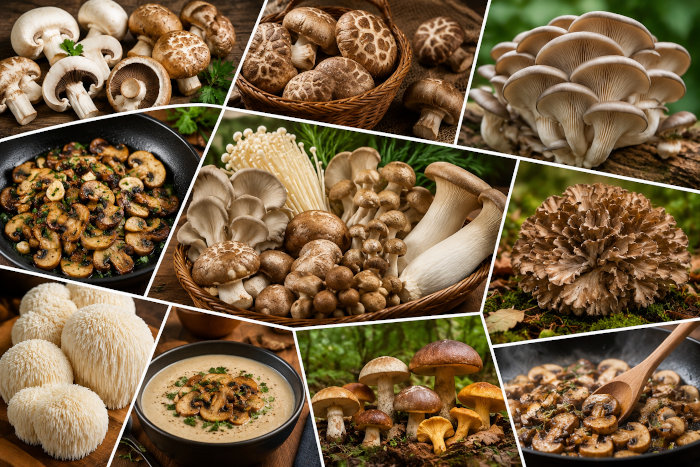
From button and portobello to shiitake, oyster, maitake, and lion's mane — exploring nutrition, umami, vitamin D, antioxidants, cooking, safety, and the remarkable world of fungi.
I love mushrooms.
Raw mushrooms.
Fried mushrooms.
Mushrooms mixed into other dishes.
They seem to add something special to almost everything.
Eggs?
Add mushrooms.
Vegetables?
Add mushrooms.
Soup?
Mushrooms.
Potatoes?
Mushrooms.
Meat?
Mushrooms.
Pizza?
Definitely mushrooms.
Grapefruit?
Okay...maybe mushrooms don't go with everything.
But mushrooms are much more than a versatile ingredient.
They represent an entirely different kingdom of life.
And nutritionally, chemically, and ecologically, they're fascinating.
Mushrooms Aren't Plants
We commonly put mushrooms in the vegetable section of the grocery store.
But biologically, mushrooms aren't vegetables.
They aren't plants at all.
Mushrooms belong to the kingdom Fungi.
Fungi are evolutionarily distinct from plants and have their own unusual biology.
Among the differences, plant cell walls contain large amounts of cellulose, while fungal cell walls contain chitin and other complex carbohydrates.
Chitin is also found in structures such as the exoskeletons of insects and crustaceans.
So when we add mushrooms to dinner, we're adding an entirely different biological kingdom to the plate.
The Mushroom Isn't Really the Whole Organism
Here's where fungi become even more interesting.
What we call a mushroom is usually only the reproductive structure of a much larger organism.
Hidden inside soil, wood, leaves, or other material is a network of tiny fungal filaments called hyphae.
Together, these networks form the mycelium.
The mushroom that suddenly appears above ground is somewhat analogous to the fruit produced by a plant.
The larger fungal organism may have been quietly living beneath the surface long before we noticed it.
Mushrooms Help Run the Forest
Fungi are enormously important to ecosystems.
Some break down dead wood and organic matter.
Without decomposers, forests would gradually accumulate enormous amounts of dead biological material while nutrients remained locked inside it.
Fungi help return those nutrients to the ecosystem.
Other fungi form remarkable relationships with living plants.
Meet the Mycorrhizal Network
Many fungi associate with plant roots in relationships known as mycorrhizae.
Fungal filaments extend through soil far beyond the reach of individual plant roots.
The fungi can help plants obtain water and minerals such as phosphorus and nitrogen.
In exchange, plants provide fungi with carbon-containing compounds produced through photosynthesis.
It's an ancient biological partnership.
So mushrooms aren't simply growing in the forest.
Fungi are helping make the forest possible.
What Do Mushrooms Give Us Nutritionally?
The nutritional composition varies by mushroom species, growing conditions, preparation, and serving size, but many common edible mushrooms provide useful amounts of nutrients while being relatively low in calories.
Depending upon the species, mushrooms can contribute:
- B vitamins
- Copper
- Selenium
- Potassium
- Phosphorus
- Fiber and fungal polysaccharides
- Small amounts of protein
- Various antioxidant and bioactive compounds
But mushrooms also contain some compounds that are unusual enough to deserve their own discussion.
Mushrooms and Vitamin D
This is one of my favorite mushroom facts.
Mushrooms contain a compound called ergosterol.
When exposed to ultraviolet light, ergosterol can be converted into vitamin D2.
Sound familiar?
Humans also use ultraviolet light to help produce vitamin D in the skin, although our chemistry produces vitamin D3 rather than the vitamin D2 commonly produced by mushrooms.
Some commercial mushroom growers deliberately expose mushrooms to ultraviolet light to increase their vitamin D content.
That's why some mushroom packages specifically advertise themselves as a source of vitamin D.
Can You Put Mushrooms in the Sun?
Interestingly, mushrooms can continue producing vitamin D2 from ergosterol after harvesting when they're exposed to appropriate ultraviolet light.
Researchers have therefore investigated sunlight and controlled UV exposure as ways of increasing mushroom vitamin D levels.
The amount produced varies considerably with the mushroom, UV exposure, time, orientation, and other conditions.
But the underlying biology is remarkable:
Light can change the nutritional composition of a mushroom sitting outside the soil.
Meet Ergothioneine
Now we get to one of the most interesting compounds in mushrooms.
Ergothioneine.
Ergothioneine is a naturally occurring sulfur-containing amino-acid derivative with antioxidant properties.
Mushrooms are among the richest dietary sources.
What's particularly fascinating is that humans possess a specialized transporter capable of efficiently taking ergothioneine into cells.
That suggests biology treats this molecule as something worth transporting and retaining.
Scientists are investigating ergothioneine in relation to oxidative stress, inflammation, cardiovascular health, neurological function, aging, and other areas.
But this is exactly where good health science needs discipline.
Interesting biology does not automatically equal proven disease treatment.
Ergothioneine is fascinating.
Mushrooms are nutritious.
Research is continuing.
That's enough reason to pay attention without turning mushrooms into miracle medicine.
Beta-Glucans and Other Mushroom Polysaccharides
Mushrooms also contain complex carbohydrates, including various beta-glucans.
Beta-glucans occur in several foods and organisms, including oats, barley, yeast, and fungi, but their chemical structures differ.
Mushroom beta-glucans and related polysaccharides have generated considerable scientific interest because of their interactions with the immune system.
Some mushroom-derived compounds are even used medically in certain countries as adjuncts in particular clinical settings.
But once again, we need an important distinction:
Eating mushrooms as food isn't the same thing as receiving a purified or concentrated mushroom-derived compound studied as a medical treatment.
Enjoy the food.
Explore the science.
But don't let supplement marketing erase the difference.
Why Do Mushrooms Make Food Taste So Good?
Now we get to the important culinary question.
Why can adding mushrooms transform a dish?
One reason is umami.
We traditionally learned about four basic tastes:
- Sweet
- Sour
- Salty
- Bitter
But humans also detect umami — the savory taste strongly associated with glutamate and related compounds.
Mushrooms naturally contain compounds that contribute to umami.
This can make a dish taste richer, deeper, and more satisfying.
Umami Can Be a Healthy Cook's Secret Weapon
This becomes particularly useful when trying to make whole foods exciting.
Healthy food doesn't need to be bland.
Mushrooms can add savory intensity to:
- Vegetable dishes
- Soups
- Stews
- Eggs
- Whole grains
- Beans
- Sauces
- Potatoes
- Meat dishes
They can even partially replace meat in some dishes while preserving a substantial savory character.
That's one reason mushrooms can be such a useful ingredient when moving toward a diet containing more whole plant foods.
White Button, Cremini, and Portobello: Surprise!
Walk through the grocery store and you'll commonly see:
White button mushrooms.
Cremini mushrooms.
Portobello mushrooms.
They look different enough that it would be reasonable to assume they're entirely different mushrooms.
But they're generally forms of the same species:
Agaricus bisporus.
White button mushrooms are familiar pale varieties harvested relatively young.
Cremini mushrooms are brown varieties harvested at a younger stage.
Portobellos are mature brown mushrooms allowed to develop much larger caps.
One species can therefore give us several very different culinary experiences.
White Button Mushrooms
These are mild, inexpensive, readily available, and incredibly versatile.
They work well:
- Raw in salads
- Sautéed
- In omelets
- In soups
- On pizza
- Mixed with vegetables
- In sauces
They're an excellent gateway mushroom.
Cremini Mushrooms
Cremini mushrooms are sometimes sold as "baby bellas."
They generally have a somewhat deeper, earthier flavor than ordinary white button mushrooms.
They're wonderful sautéed and can add richness to soups, stews, sauces, eggs, and vegetable dishes.
Portobello Mushrooms
Let that same mushroom mature and you get something very different.
Portobello caps are large and substantial.
Their texture makes them useful for grilling, roasting, stuffing, or using as the centerpiece of a dish.
A mature mushroom can provide an almost meat-like culinary experience without actually trying to imitate meat chemically.
Shiitake Mushrooms
Shiitake mushrooms have a much stronger personality.
They're prized for their deep savory flavor and have a long history in East Asian cooking.
Fresh shiitake are excellent, but drying them can intensify and alter their flavor dramatically.
Dried mushrooms are particularly useful in soups and broths because their soaking liquid can itself become a flavorful ingredient.
Oyster Mushrooms
Oyster mushrooms grow in beautiful clusters and have a tender texture and mild flavor.
They cook quickly and work wonderfully in stir-fries, sautés, soups, and mixed vegetable dishes.
They also provide an excellent example of fungi's role as decomposers because many oyster mushroom species naturally grow on dead or dying wood.
Maitake — Hen of the Woods
Maitake, often called hen of the woods, grows in large, layered clusters.
It has a rich flavor and interesting texture.
Maitake has also attracted considerable scientific interest because of its polysaccharides and beta-glucans.
But even without the research excitement, it deserves attention for a simpler reason:
It tastes good.
Lion's Mane
Lion's mane may be one of the strangest-looking edible mushrooms.
Instead of the familiar cap-and-stem shape, it produces cascading white structures resembling a shaggy mane.
Lion's mane has become particularly popular because researchers are investigating compounds called hericenones and erinacines and their potential effects involving nerve-growth pathways and neurological function.
Early laboratory, animal, and limited human research has generated legitimate scientific interest.
But marketing has moved much faster than the evidence.
It's reasonable to call lion's mane an interesting food being actively researched.
It's premature to call it a proven treatment for neurological disease.
Raw Mushrooms or Cooked?
Both can have a place at the table.
Raw mushrooms provide a crisp texture and mild flavor that works particularly well in salads.
Cooking changes them considerably.
Heat softens fungal cell structures, reduces water content, changes aromatic compounds, and can make some components more accessible during digestion.
Cooking also dramatically develops flavor.
That's why mushrooms that taste mild when raw can become intensely savory after sautéing or roasting.
What About Agaritine?
Common Agaricus mushrooms contain a naturally occurring compound called agaritine.
Agaritine has attracted scientific attention because some laboratory and animal experiments raised questions about potential toxicity.
However, translating those findings into meaningful risk from ordinary human mushroom consumption is complicated.
Agaritine levels also decrease during storage and with various cooking methods.
This isn't a reason to panic about occasionally eating raw button mushrooms.
It is another reason that eating mushrooms in a variety of ways — including cooked — is sensible.
The Magic of the Hot Pan
One of the easiest ways to transform mushrooms is heat.
Put mushrooms into a hot pan and they initially release considerable water.
Continue cooking and the water evaporates.
Then browning begins.
Now flavor becomes concentrated and new flavor compounds develop through heat-driven chemical reactions.
Add a little olive oil.
Maybe onions.
Garlic.
Black pepper.
Herbs.
Suddenly a simple fungus has become one of the most flavorful things on the plate.
Don't Crowd the Pan
If you're trying to brown mushrooms, give them some room.
A pan packed tightly with mushrooms traps released moisture.
Instead of browning, the mushrooms tend to steam.
That's not necessarily bad if steaming is what you want.
But if you're looking for rich browned flavor:
Give the water somewhere to go.
Mushrooms Go With Almost Everything
This may be their greatest practical nutritional advantage.
A food can contain fascinating compounds, but that doesn't help much if nobody wants to eat it.
Mushrooms are easy to incorporate into meals.
Try them with:
- Eggs and omelets
- Onions and peppers
- Potatoes
- Rice
- Whole grains
- Beans and lentils
- Pasta
- Soups
- Stews
- Chicken
- Beef
- Fish
- Leafy greens
- Pizza
- Sandwiches
- Salads
And probably many things we haven't thought of yet.
But we're still leaving grapefruit alone.
Fresh Versus Dried Mushrooms
Dried mushrooms deserve their own place in the pantry.
Removing water concentrates flavors and allows mushrooms to be stored for long periods.
Rehydrate them in warm water and they can be used in soups, sauces, grains, and stews.
And don't automatically throw away the soaking liquid.
After appropriate straining to remove grit, that deeply flavored liquid can sometimes become part of the broth or sauce.
It's essentially mushroom flavor waiting to be used.
What About "Medicinal Mushrooms"?
This is where mushrooms move from food science into an enormous supplement industry.
You'll see claims involving:
- Immune enhancement
- Cancer treatment
- Brain function
- Energy
- Longevity
- Stress reduction
- Blood sugar
- Cholesterol
Some mushroom species and mushroom-derived compounds genuinely are being investigated scientifically.
Some findings are intriguing.
But there's an enormous difference between:
"Scientists are studying this."
and
"This has been proven to treat disease."
Supplement advertising doesn't always respect that distinction.
Our approach can be simpler.
Enjoy edible mushrooms as whole foods.
Follow the research.
Remain curious.
And don't turn promising laboratory findings into medical conclusions before the evidence gets there.
Wild Mushrooms: This Is Where We Need to Be Serious
Walking through the woods and discovering mushrooms can be fascinating.
Some wild mushrooms are delicious.
Some are poisonous.
And some deadly mushrooms can resemble edible species closely enough that mistakes can have catastrophic consequences.
Never eat a wild mushroom simply because it resembles a photograph in a book, website, app, or AI-generated identification.
Mushroom identification can require examining multiple characteristics, including:
- Cap structure
- Gills or pores
- Stem characteristics
- Spore color
- Bruising reactions
- Odor
- Growth pattern
- Habitat
- Associated trees
- Microscopic characteristics
Even experienced mushroom enthusiasts approach identification carefully.
Cooking Doesn't Make Every Mushroom Safe
This is another dangerous misconception.
Some mushroom toxins survive ordinary cooking.
Frying, boiling, drying, freezing, or otherwise preparing an unknown mushroom does not automatically make it edible.
Identification comes first.
Don't Experiment With "Just a Little"
Taste Bud Boot Camp encouraged trying small amounts of unfamiliar healthy foods.
Wild mushroom identification is an exception!
An unidentified mushroom is not something to sample to see what happens.
The rule here is very different:
If you don't know exactly what it is, don't eat it.
Edible Mushrooms Boot Camp Challenge
Instead of beginning with wild mushrooms, explore the growing variety available through grocery stores, farmers markets, and reputable mushroom growers.
If you normally eat only white button mushrooms, try:
- Cremini
- Portobello
- Shiitake
- Oyster
- Maitake
- Lion's mane
Cook them individually at first.
Learn their textures.
Learn their aromas.
Notice how differently they brown.
Then begin combining them with foods you already enjoy.
A Whole New Kingdom on the Plate
One of the recurring lessons from our Whole Foods Boot Camps is variety.
Different foods provide different nutrients, fibers, phytochemicals, textures, and flavors.
Mushrooms expand that idea even further.
They're not another vegetable.
They're not another fruit.
They're fungi.
Adding mushrooms means adding another kingdom of biology to our diet.
The Bigger Mushroom Story
Maybe that's what makes mushrooms so interesting.
They taste wonderful.
They add umami to food.
They provide useful nutrients.
Some can produce vitamin D when exposed to ultraviolet light.
They're rich dietary sources of unusual compounds such as ergothioneine.
Their beta-glucans and other molecules continue to attract scientific attention.
They decompose dead material.
They recycle nutrients.
They cooperate with plants.
They help forests function.
And most of the fungal organism may be hidden beneath our feet while we're looking at the mushroom above ground.
Then we bring that mushroom into the kitchen...
Put it in a hot pan...
Add some onions and garlic...
And eat it for supper.
That's quite a journey for one ingredient.
Eat the Mushroom — Explore the Science
Mushrooms don't need miracle health claims to deserve a place in a healthy diet.
They're already interesting enough.
They're nutritious.
They're versatile.
They're flavorful.
They're biologically unique.
And there are dozens of culinary varieties waiting to be explored.
Perhaps the best healthy-eating strategy isn't asking:
"Which mushroom is the healthiest?"
Maybe it's:
"Which mushrooms haven't I tried yet?"
Because healthy eating becomes much easier when exploring whole foods is something we actually enjoy.
And fortunately...
Mushrooms go with almost everything.
Almost.
We're still not putting them on the grapefruit.
Zehr.ws Health Perspective: Edible mushrooms can be nutritious components of a varied whole-food diet, but nutritional composition differs among species and growing conditions. Research into mushroom-derived compounds does not mean that mushrooms or mushroom supplements have been proven to prevent or treat particular diseases. Never consume an unidentified wild mushroom based solely on photographs, apps, websites, or AI identification. Some poisonous mushrooms closely resemble edible species, and cooking may not destroy their toxins. When foraging, identification should come from qualified local expertise and multiple reliable characteristics. Anyone who becomes ill after eating a mushroom should seek prompt medical or poison-control guidance.

Exploring Health, Longevity, and Better Living
Zehr.ws