062 Turmeric & Curcumin: Ancient Spice, Modern Supplement — What Does the Research Say?
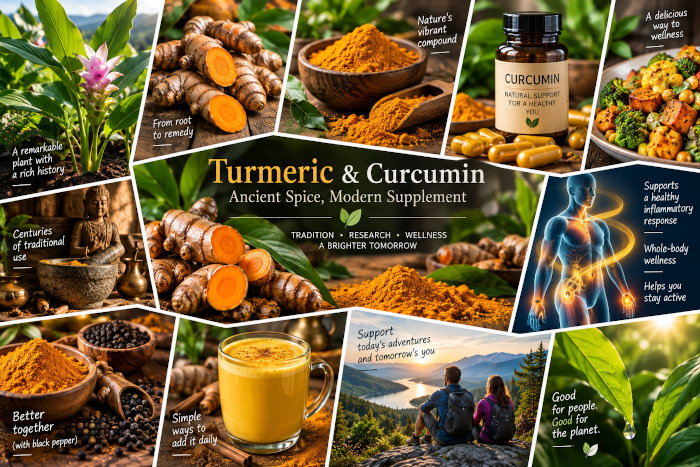
Understanding Supplements Collection
Turmeric has been used as a food and spice for centuries. Today, however, turmeric has another identity: it has become one of the most popular dietary supplements, often promoted for inflammation, joint health, heart health, brain health and general wellness.
That raises an interesting question:
Is adding turmeric to our food the same thing as taking a concentrated curcumin supplement?
Not really.
And understanding the difference provides a wonderful example of how we can think about food, plant compounds and modern supplements.
What Is Turmeric?
Turmeric comes from Curcuma longa, a plant belonging to the ginger family. The underground stem, or rhizome, is dried and ground to produce the familiar golden-yellow spice.
Turmeric has a long culinary history, particularly in India and Southeast Asia, and has also been used in several traditional systems of medicine.
Its brilliant yellow-orange color comes largely from a group of compounds known as curcuminoids.
The best known of these is curcumin.
Turmeric and Curcumin Are Not Quite the Same Thing
This distinction is important.
Turmeric is the whole plant-derived food or spice.
Curcumin is one of the biologically active compounds found within turmeric.
Whole turmeric contains curcumin along with many other naturally occurring components. A curcumin supplement, on the other hand, may contain a concentrated extract designed to provide much larger quantities of curcuminoids than we would normally get from seasoning food.
That means research involving concentrated curcumin supplements cannot automatically be translated into claims about sprinkling turmeric onto dinner—and the reverse is also true.
Using Turmeric as a Spice
Before we ever reach for a supplement bottle, there is another possibility:
Eat it.
Turmeric works well in soups, stews, curries, rice, vegetables, eggs, lentils, beans and many other dishes.
It can be combined with garlic, ginger, cumin, black pepper and other spices to create flavorful foods without relying heavily on salt, sugar or rich sauces.
This is one of the reasons spices are so interesting nutritionally. They aren't simply potential sources of biologically active compounds. They can also help make vegetables, legumes and other nutritious foods more enjoyable.
That indirect benefit may be every bit as important as the compounds researchers isolate from the spice.
Why Is Curcumin So Interesting?
Curcumin has been extensively investigated in laboratory research because it interacts with numerous biological pathways associated with inflammation and oxidative processes.
This has generated enormous interest in whether curcumin might help with inflammatory conditions and other diseases.
But there is an important lesson here:
Something working in a laboratory does not automatically mean that taking it as a supplement produces a meaningful health benefit in humans.
Human clinical trials are where that question has to be answered.
Turmeric, Curcumin and Inflammation
“Reduces inflammation” is probably the claim most closely associated with turmeric.
There are plausible biological mechanisms and interesting experimental findings behind the idea. Some clinical trials also report changes in inflammatory markers.
However, inflammation is not one single disease, and reducing a laboratory marker is not necessarily the same thing as improving a person's health.
The National Center for Complementary and Integrative Health currently concludes that there is not enough evidence to definitively determine that turmeric or curcumin is beneficial for health purposes in general.
That doesn't mean the research has failed.
It means the evidence is still developing.
Joint Pain and Osteoarthritis
This is one area where the evidence becomes particularly interesting.
Multiple systematic reviews and meta-analyses have examined turmeric or curcuminoid supplements for osteoarthritis, especially knee osteoarthritis.
Some studies report improvements in pain, stiffness, joint mobility and function.
The early evidence is encouraging enough to justify continued research, but researchers have also pointed out important limitations: studies use different products, different doses, different formulations and different methods of increasing absorption.
Where the evidence stands: curcumin may help some people with osteoarthritis symptoms, but better and more standardized trials are needed before we can confidently determine which preparation, dose and population benefit most.
Heart and Metabolic Health
Curcumin has also been studied for effects on blood lipids, blood pressure, glucose regulation and metabolic conditions such as nonalcoholic fatty liver disease.
Some trials and meta-analyses report improvements in individual measurements.
Again, however, results vary considerably between studies and formulations.
This makes turmeric interesting to researchers, but it doesn't make a curcumin capsule a replacement for exercise, nutritious food, healthy body composition, appropriate medical treatment or other established approaches to cardiovascular and metabolic health.
What About the Brain?
Because inflammation and oxidative stress are being investigated in relation to brain aging and neurological disease, curcumin has naturally attracted attention here as well.
You may therefore see claims that curcumin improves memory, protects the brain or prevents cognitive decline.
Those claims currently run ahead of what can confidently be concluded from clinical research.
It is an interesting research area—but “interesting” and “proven” are not interchangeable words.
The Curcumin Absorption Problem
Curcumin presents researchers and supplement manufacturers with a problem:
Ordinary curcumin is not absorbed particularly well.
That has led manufacturers to develop formulations intended to increase its bioavailability—the amount that ultimately becomes available to the body.
One familiar strategy involves combining curcumin with piperine, a compound found in black pepper.
Other supplements use specialized particles, lipid formulations or other delivery technologies.
Improved absorption sounds automatically desirable.
But there is another side to the story.
Black Pepper: An Interesting Partner
Black pepper deserves its own future article, but its relationship with curcumin is worth mentioning here.
Piperine can increase curcumin's bioavailability, which is why black pepper extract frequently appears on curcumin supplement labels.
This is fascinating from a pharmacological perspective. A compound from one spice can alter how the body handles a compound from another.
But dramatically increasing absorption also changes the exposure of the body to that compound.
That brings us to an important safety issue.
Highly Bioavailable Doesn't Automatically Mean Better
Some newer curcumin supplements are specifically engineered to produce much higher absorption.
Recent reports have associated turmeric and curcumin supplements—particularly some highly bioavailable formulations—with rare cases of clinically significant liver injury.
Most reported patients recover after discontinuing the product, but severe cases have occurred.
This does not mean that normal culinary use of turmeric is dangerous, nor does it mean that everyone taking a curcumin supplement will experience liver problems. Such reactions appear to be uncommon.
It does demonstrate something extremely important about supplements:
Increasing the amount of a plant compound that enters the body can potentially increase effects we want—and effects we don't want.
Food Is Not Necessarily the Same as an Extract
This distinction deserves special attention throughout our supplement series.
Eating a plant that humans have consumed traditionally is one exposure.
Extracting one of its compounds, concentrating it into a capsule and engineering that compound for much greater absorption can create a very different exposure.
Neither approach is automatically good or bad.
They are simply not equivalent.
This is why saying that a supplement is “natural” tells us surprisingly little about its effectiveness or safety.
How Much Turmeric Should We Use in Food?
There is no established requirement for turmeric because turmeric is not an essential nutrient.
When it is being used as a culinary spice, there usually isn't a need to think of it as a precise dose.
Use it because you enjoy it.
Try it with vegetables, soups, rice, beans, lentils, eggs or other foods. Combine it with garlic, ginger, cumin or black pepper. Experiment.
That is quite different from consuming a standardized extract containing hundreds or thousands of milligrams of concentrated material.
What Should We Look For in a Curcumin Supplement?
If someone chooses to use a turmeric or curcumin supplement, the front of the bottle doesn't tell the whole story.
Useful questions include:
- Is this whole turmeric or a concentrated curcumin extract?
- How much curcumin or curcuminoids does it provide?
- Does it contain piperine or black pepper extract?
- Has it been formulated specifically for enhanced absorption?
- What dose was used in the research supporting the claim?
- Has the product been independently tested for quality?
- Could it interact with medications or health conditions?
The phrase “enhanced absorption” should not automatically be interpreted as “healthier.” It simply means exposure may be greater.
What About Taking Turmeric Occasionally?
There is an important difference between using turmeric occasionally in food and taking a concentrated supplement with the expectation of producing a therapeutic effect.
Research generally studies defined doses taken according to a schedule. We do not have good evidence showing that randomly rotating curcumin with other supplements provides special benefits or prevents the body from “getting used to” it.
Occasional use may reduce total exposure compared with daily supplementation, but it also makes any expected therapeutic effect difficult to predict.
That is another useful principle for evaluating supplements: if we are taking something for a particular health benefit, we should ask whether the way we are taking it resembles the way it was actually studied.
Can Turmeric Have Side Effects?
Yes.
Oral turmeric or curcumin supplements can cause digestive symptoms such as nausea, reflux, stomach upset, diarrhea or constipation.
People taking medications, people with existing medical conditions, and anyone considering high-dose or highly bioavailable curcumin supplements should discuss their use with a physician or pharmacist.
Symptoms that could indicate liver injury—including unusual fatigue, nausea, loss of appetite, dark urine or yellowing of the skin or eyes—warrant stopping the supplement and seeking medical advice.
Spice Rack or Supplement Bottle?
Perhaps we shouldn't always treat this as an either/or decision.
Turmeric can simply be part of a varied diet.
Using turmeric as a spice adds flavor, color and variety to food while exposing us to a complex mixture of naturally occurring plant compounds.
A curcumin supplement represents something different: a concentrated intervention that might be useful for a particular purpose but deserves to be evaluated according to clinical evidence, dose, formulation and safety.
That distinction is important.
A Better Way to Think About Supplements
As with other supplements, we can begin with questions rather than the bottle:
- What is it?
- Is it an essential nutrient, a food, a plant extract or an isolated compound?
- What does research in humans actually show?
- Are the studies testing the same form sold in the supplement?
- What dose was studied?
- Does improving absorption change the risks as well as the potential benefits?
- Could we reasonably incorporate the original food or spice into our diet?
- What side effects or interactions should we consider?
Where It Stands
Turmeric is a wonderful spice. Curcumin is an intriguing plant compound. Curcumin supplements are promising in some areas—but they aren't miracle capsules.
The most encouraging clinical evidence currently involves conditions such as osteoarthritis, where some studies suggest improvements in pain and function. Research into inflammation, metabolic health and other conditions continues, but many broader health claims remain ahead of the evidence.
Using turmeric regularly as part of cooking is also quite different from taking concentrated, highly bioavailable curcumin extracts.
And perhaps that's the larger lesson.
We don't always have to extract, concentrate and encapsulate something before it can become part of a healthy life.
Sometimes it can simply go into dinner.
Research & Further Reading
National Center for Complementary and Integrative Health (NCCIH). Turmeric: Usefulness and Safety. Updated April 2025.
National Institute of Diabetes and Digestive and Kidney Diseases. LiverTox: Turmeric.
Feng J, et al. Efficacy and safety of curcuminoids alone in alleviating pain and dysfunction for knee osteoarthritis: a systematic review and meta-analysis of randomized controlled trials. BMC Complementary Medicine and Therapies. 2022.
Ebrahimzadeh A, et al. Curcumin effects on glycaemic indices, lipid profile, blood pressure, inflammatory markers and anthropometric measurements of non-alcoholic fatty liver disease patients: a systematic review and meta-analysis of randomized clinical trials. Complementary Therapies in Medicine. 2024.
Zehr.ws provides educational information and is not a substitute for individualized medical advice. Supplements can have side effects and interact with medications and health conditions.

Exploring Health, Longevity, and Better Living
Zehr.ws