067 Garlic: Ancient Food, Fascinating Chemistry
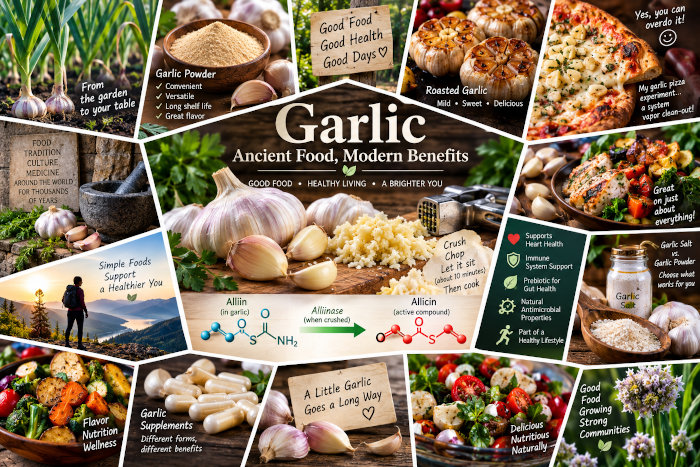
Garlic is one of those remarkable foods that seems to belong everywhere. It is a vegetable, an herb, a seasoning, a traditional remedy, and the subject of a surprising amount of modern scientific research.
For thousands of years, people around the world have valued garlic not only for the flavor it adds to food, but also for its possible effects on health. Today, researchers are still investigating garlic and the sulfur-containing compounds that give it its distinctive smell, taste, and biological activity.
And unlike many foods associated with health, garlic is easy to use. It can be chopped, crushed, roasted, cooked into meals, or simply shaken onto food as garlic powder.
What Makes Garlic So Interesting?
A whole garlic clove contains a sulfur-containing compound called alliin and an enzyme called alliinase. While the garlic cells remain intact, these are largely kept apart.
Something interesting happens when garlic is chopped, crushed, or chewed.
Breaking the cells allows alliinase to act on alliin, rapidly producing allicin and ultimately a variety of other sulfur-containing compounds.
This is one reason freshly crushed garlic is so dramatically different from an intact clove. Crushing the garlic essentially starts a small chemical factory.
Those sulfur compounds contribute to garlic's unmistakable aroma and sharp flavor, and many of them have also become the focus of scientific research.
Why Can Raw Garlic Taste Hot?
Anyone who has bitten into freshly crushed raw garlic knows that garlic can have considerably more than just flavor. It can produce an intense burning or spicy sensation in the mouth.
That sensation comes largely from the reactive sulfur chemistry created when fresh garlic is damaged. Raw garlic can even irritate the tissues of the mouth and digestive system when consumed in large amounts.
Cooking changes that chemistry considerably. Heat inactivates alliinase and transforms many of garlic's sulfur compounds, which is why cooked garlic generally becomes much milder.
Roasting takes the transformation even further. Roasted garlic can become soft, sweet, and almost buttery—a remarkable contrast to the sharp bite of a freshly crushed clove.
A Garlic Pizza Experiment
I learned firsthand just how powerful fresh garlic can be while making pizza.
A friend who made pizza would crush fresh garlic and put the resulting garlic juice on the pizza. When I tried making it myself, I looked at all the crushed garlic that remained and thought: Why throw that away? It's all good!
So instead of using only the juice, I put the crushed garlic on the pizza too.
I apparently used quite a bit.
The pizza was surprisingly hot from the fresh garlic, and I could still taste and smell garlic well into the following day. It felt almost like a complete garlic vapor clean-out!
It was also a memorable demonstration of just how different freshly crushed garlic can be from the mild garlic flavor we often experience in cooked foods.
Fresh Garlic and the 10-Minute Idea
If you are using fresh garlic, there is an interesting technique that may help preserve some of its characteristic sulfur chemistry.
Crush or chop the garlic and allow it to sit for approximately 10 minutes before cooking it.
Why?
Crushing brings alliin and alliinase together. Giving the chopped garlic a little time before exposing it to high heat allows the enzyme reactions to occur and sulfur compounds to begin forming.
Heat eventually inactivates alliinase, so immediately putting freshly chopped garlic into a very hot pan can interrupt that initial chemistry.
This does not mean garlic must always be prepared this way, or that waiting 10 minutes transforms dinner into medicine. It is simply an interesting way of working with garlic's natural chemistry.
What About Garlic Powder?
Fresh garlic gets most of the attention, but garlic powder deserves a place in the conversation too.
Garlic powder is produced by dehydrating garlic and grinding it into a fine powder. Depending on how it is processed, properly produced garlic powder can retain alliin and alliinase activity. When the powder is exposed to moisture, some of the same chemistry associated with crushed fresh garlic can occur.
That makes garlic powder more interesting than simply being "garlic flavor."
It is also extremely practical. A container can sit in the spice cabinet ready to add garlic to vegetables, potatoes, eggs, soups, meats, sauces, pizza, and countless other foods.
I use garlic powder frequently for exactly this reason. Sometimes instead of preparing fresh garlic, I simply grab the garlic powder and sprinkle it over whatever food I am eating.
Fresh garlic and garlic powder do not have identical chemical profiles, and processing methods vary between products. But there is no reason to think of garlic powder as an inferior food that should be avoided. It can be another convenient way of incorporating garlic into the diet.
Garlic Powder Is Not Garlic Salt
There is an important distinction between garlic powder and garlic salt.
Garlic powder is primarily dehydrated, ground garlic. Garlic salt combines garlic with a substantial amount of salt.
Both can be useful seasonings, but if the goal is simply to add more garlic flavor without substantially increasing sodium, plain garlic powder gives you much greater control.
Garlic and Cardiovascular Health
One of the most studied areas of garlic research involves cardiovascular health.
Clinical studies and reviews suggest that certain garlic preparations may produce modest reductions in blood pressure, particularly among people who already have elevated blood pressure.
Research has also examined garlic's effects on blood lipids. Some studies have reported modest reductions in total cholesterol and LDL cholesterol, although results vary depending on the garlic preparation, dose, study population, and duration.
Garlic should not be viewed as a replacement for prescribed blood-pressure or cholesterol medication. But the research provides another reason why garlic is an interesting component of an overall healthy dietary pattern.
Garlic and the Immune System
Garlic has a long traditional association with resistance to illness, and researchers continue to investigate how garlic compounds interact with immune cells and inflammatory signaling.
Laboratory studies show numerous biological effects, but laboratory activity does not automatically mean that eating garlic will prevent or cure an infection.
Human research investigating colds and other respiratory illnesses is interesting but still limited.
A better way to think about garlic is as one of many plant foods that provide biologically active compounds as part of a varied diet—not as an antibiotic hiding in the vegetable drawer.
Garlic and Microorganisms
Allicin and other garlic compounds can inhibit certain bacteria, fungi, and other microorganisms under laboratory conditions.
This probably contributed to garlic's long reputation as a medicinal plant.
But there is an enormous difference between inhibiting microorganisms in a laboratory dish and successfully treating an infection inside the human body.
Garlic is fascinating biology. It is not a substitute for appropriate medical treatment when an infection requires it.
Garlic May Feed More Than You
Garlic also contains fructans, carbohydrates that can serve as food for certain beneficial intestinal microorganisms.
In this sense, garlic can have prebiotic properties.
There is another side to this story, however. Fructans are fermentable carbohydrates, and people who are particularly sensitive to them may experience gas, bloating, or abdominal discomfort after eating garlic.
This is another good example of something we see repeatedly in nutrition: a food can be healthy while still not agreeing with every digestive system.
Fresh, Cooked, Roasted, or Powdered?
There probably isn't one "best" form of garlic.
Fresh crushed garlic provides the most dramatic alliinase-driven chemistry and the strongest flavor.
Cooked garlic is milder and extremely easy to incorporate into meals.
Roasted garlic becomes sweet, soft, and wonderfully flavorful.
Garlic powder is convenient, shelf-stable, inexpensive, and easy to sprinkle onto everyday foods.
Using several forms may actually be the most enjoyable approach.
What About Garlic Supplements?
Garlic supplements introduce another layer of complexity.
Products may contain garlic powder, garlic oil, aged garlic extract, or preparations designed to provide particular sulfur compounds. These products are not chemically identical, which helps explain why studies using different garlic supplements sometimes produce different results.
Aged garlic extract, for example, contains a different mixture of sulfur compounds than freshly crushed garlic.
This is an important reminder that a study involving one standardized garlic preparation cannot automatically be applied to every garlic supplement—or to a clove of garlic eaten with dinner.
Can You Get Too Much Garlic?
With ordinary culinary amounts, garlic is generally well tolerated by most people. Large quantities—particularly raw garlic—can cause heartburn, stomach upset, gas, nausea, or irritation of the mouth and digestive tract.
And yes, enough fresh garlic may make your presence known to everyone around you for quite some time!
Garlic compounds can be absorbed and metabolized, and some volatile sulfur compounds eventually leave the body through the breath and other routes. That helps explain why an especially enthusiastic garlic meal can seem to follow you around long after dinner is over.
Concentrated garlic supplements also deserve additional caution because garlic can have antiplatelet effects. People taking anticoagulant or antiplatelet medications, those with bleeding disorders, or people preparing for surgery should discuss substantial supplemental garlic use with their healthcare professional.
Don't Turn a Good Food Into a Megadose
Garlic illustrates an important principle that applies to many foods we discuss on Zehr.ws.
If something is beneficial, it does not automatically follow that enormous amounts are even more beneficial.
Garlic doesn't have to become a treatment or a megadose supplement to be valuable.
It can simply be garlic.
Use fresh garlic when you want its powerful flavor. Roast it when you want something mellow and sweet. Cook it into sauces and meals. Keep garlic powder nearby when you want an effortless sprinkle of flavor.
And perhaps exercise just a little restraint when covering an entire pizza with freshly crushed garlic!
The Bottom Line
Garlic has traveled an extraordinary path through human history—from ancient food and traditional remedy to the modern kitchen and research laboratory.
Its chemistry is genuinely fascinating. Simply crushing a clove initiates enzymatic reactions that create entirely new compounds. Those compounds help produce garlic's characteristic flavor and aroma and may contribute to some of the health effects scientists continue to investigate.
The strongest evidence does not turn garlic into a miracle medicine. Instead, it supports something much more practical.
Garlic is a flavorful plant food with interesting biological properties that fits beautifully into a healthy, varied diet.
Fresh, roasted, cooked, or powdered—it gives us plenty of ways to enjoy it.
Just remember: when it comes to freshly crushed garlic on pizza, I have personally demonstrated that there really can be too much of a good thing!

Exploring Health, Longevity, and Better Living
Zehr.ws