068 Black Pepper: The King of Spices
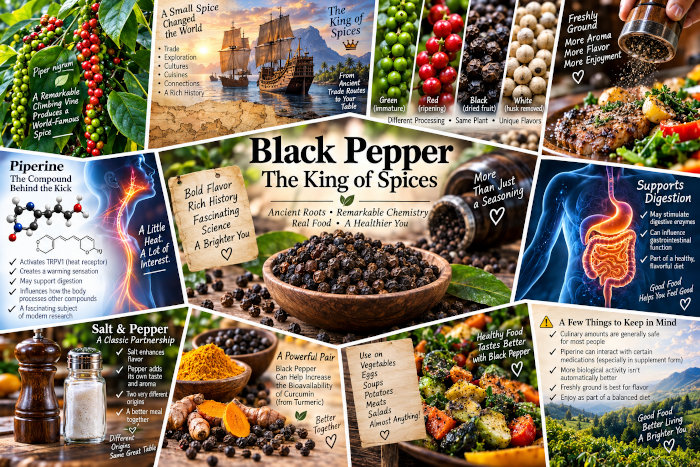
There are few foods in my kitchen that don't have the potential to receive a little black pepper.
Or perhaps quite a bit of black pepper.
Some people put a little pepper on their food. I sometimes seem to approach it from the opposite direction: put some food under the black pepper.
Black pepper is one of my favorite seasonings, especially alongside a little salt. But that familiar pepper shaker contains a surprisingly remarkable story.
Black pepper has influenced international trade, exploration, cooking, traditional medicine, and even economics. Its characteristic bite comes from an intriguing natural chemical called piperine, which researchers are still studying today.
And those little black peppercorns?
They're actually dried fruits.
Meet Piper nigrum
Black pepper comes from Piper nigrum, a perennial climbing vine in the Piperaceae family.
The plant originated in tropical South Asia and became particularly associated with the pepper-growing regions of India.
Instead of producing individual peppercorns, the vine develops clusters of small fruits along elongated spikes. Each little fruit can eventually become the peppercorn that ends up in our grinders and pepper shakers.
That means something we casually sprinkle over eggs, vegetables, potatoes, soups, meat, and countless other foods begins life growing on a tropical vine.
The King of Spices
Black pepper has often been called the "King of Spices," and its history helps explain why.
Pepper has been traded for thousands of years. It traveled from South Asia through complex trading networks into the Middle East, Mediterranean world, Europe, and eventually around the globe.
For centuries, spices such as pepper were valuable commodities. They could travel enormous distances, were relatively lightweight, stored well when properly dried, and dramatically changed the flavor of food.
European demand for Asian spices also became one of several important forces behind the search for new maritime trade routes.
So that inexpensive container of pepper sitting in the modern kitchen is connected to an extraordinary history of agriculture, merchants, ships, empires, exploration, and global trade.
From Luxury to Everyday Seasoning
One of the remarkable things about black pepper is how ordinary it has become.
Something that once traveled across continents through expensive and complicated trade networks can now be purchased inexpensively in almost any grocery store.
We sprinkle it onto dinner without giving it much thought.
But historically, pepper was valuable enough to be associated with wealth and international commerce.
Few foods demonstrate quite so dramatically how global agriculture and transportation have transformed what ordinary people can keep in their kitchens.
What Makes Black Pepper Hot?
The characteristic pungency of black pepper comes primarily from an alkaloid called piperine.
Piperine doesn't produce exactly the same sensation as the capsaicin in hot peppers, but the two share some interesting biology.
Piperine can activate TRPV1, a sensory receptor involved in our perception of heat and chemical irritation.
In other words, black pepper doesn't actually have to raise the temperature of your mouth to create a warming sensation.
It interacts with sensory receptors that help your nervous system detect something as "hot."
That's some impressive chemistry for a pepper grinder.
Piperine: More Than Flavor
Piperine is one of the most extensively studied compounds in black pepper.
Researchers have investigated its possible antioxidant, anti-inflammatory, metabolic, neurological, antimicrobial, and other biological effects.
There is an important caution, however.
Much of this research has been conducted in cells or animals, often using purified piperine at concentrations very different from those obtained by putting pepper on dinner.
Laboratory findings are useful for discovering mechanisms and identifying promising areas of research, but they do not automatically demonstrate a health benefit in humans.
That distinction is especially important with spices, where an interesting molecule can quickly acquire a much larger reputation on the Internet than the human evidence actually supports.
Black Pepper and Digestion
Black pepper has a long traditional association with digestion, and there is some interesting science behind that reputation.
Experimental research suggests that piperine and pungent spices can influence digestive physiology, including the activity of certain digestive enzymes.
Studies have reported stimulation of pancreatic digestive enzymes and changes in gastrointestinal transit under experimental conditions.
That doesn't mean adding pepper to dinner is a treatment for digestive disorders.
But it does reinforce an interesting theme we encounter repeatedly with herbs and spices:
Flavor compounds don't necessarily stop working when we swallow them.
They can interact with receptors, enzymes, microorganisms, and tissues throughout the digestive process.
Freshly Ground Pepper Really Is Different
If you've ever compared freshly cracked black pepper with pepper that has been sitting pre-ground in a container for months, you may have noticed a substantial difference.
Piperine provides much of pepper's pungency, but black pepper also contains numerous volatile aromatic compounds and essential oils.
These compounds contribute floral, citrusy, woody, earthy, and other subtle aromas.
A whole peppercorn helps protect those compounds.
Grinding dramatically increases the exposed surface area. Once pepper has been ground, volatile compounds can escape into the air and oxidation can gradually alter its flavor.
That's why freshly cracking peppercorns over food can produce such a wonderful burst of aroma.
You aren't just grinding the pepper smaller.
You are releasing its chemistry.
Black, White & Green Pepper: The Same Plant?
Here's one of my favorite facts about pepper.
Black pepper, white pepper, and green peppercorns can all come from the same plant: Piper nigrum.
The differences come largely from the maturity of the fruit and how it is processed.
Green peppercorns are green berries that are preserved or dried in ways designed to retain their green character.
Black peppercorns retain their outer fruit layer and become dark and wrinkled during processing and drying.
White pepper is produced by removing the outer portion of the fruit, leaving the lighter-colored seed.
The resulting seasonings look and taste different even though they originated from the same species.
It's a wonderful example of how processing can transform a single agricultural product into several different foods.
And What About Pink Peppercorns?
Here's another fun twist.
The pink peppercorns commonly found in colorful peppercorn mixtures usually aren't Piper nigrum at all.
They typically come from plants in the genus Schinus, which belong to a different botanical family.
They resemble peppercorns and have a peppery character, so they joined the culinary pepper family even though botanically they're something different.
Why Black Pepper and Salt?
Salt and pepper have become such familiar partners that we rarely stop to think about how completely different they are.
Salt is a mineral.
Black pepper is a fruit.
One ultimately comes from mineral deposits or salty water.
The other grows on a tropical climbing vine.
Salt primarily modifies and enhances our perception of flavors already present in food. Black pepper brings an entirely new collection of aromas and pungent compounds to the meal.
One enhances.
One adds.
Together they became one of the most familiar seasoning combinations in the world.
For me, a little salt and plenty of freshly ground black pepper can make an amazing number of foods better.
Black Pepper Meets Turmeric
Our earlier discussion of turmeric and curcumin leads directly into one of the most interesting properties of black pepper.
Piperine can influence the bioavailability of other compounds.
Bioavailability describes how much of a substance ultimately becomes available to the body after it is consumed.
Curcumin, one of the principal compounds studied in turmeric, naturally has relatively poor oral bioavailability.
Piperine has therefore been investigated as one way of altering curcumin absorption and metabolism.
This is why turmeric supplements frequently contain black pepper extract or piperine.
But "Black Pepper Makes Turmeric Work" Is Too Simple
You may encounter very specific claims about black pepper increasing curcumin absorption by an enormous percentage.
The actual science is more complicated.
Bioavailability depends on dose, formulation, metabolism, timing, the compound being measured, and many other factors.
Piperine can affect intestinal transport and enzymes involved in metabolizing compounds. That can sometimes increase exposure to substances that would otherwise be rapidly metabolized.
This is scientifically fascinating.
But it also creates an important question.
If piperine can change the way the body handles something we want to absorb, what else might it change?
Piperine and Medications
This is where we need to distinguish between using black pepper as food and taking concentrated piperine supplements.
Piperine can interact with enzymes and transport systems involved in the absorption and metabolism of drugs.
Researchers actually study piperine partly because of its ability to increase the bioavailability of other compounds.
But greater bioavailability isn't always desirable.
A medication is prescribed with an intended dose and expected concentration in the body. Substantially changing its absorption or metabolism could potentially change its effects or side effects.
Normal culinary use of black pepper is very different from swallowing a concentrated piperine extract.
People taking prescription medications should therefore be cautious about adding high-dose piperine or "bioavailability enhancer" supplements without discussing them with a pharmacist or healthcare professional.
More Biological Activity Isn't Automatically Better
This gives us another excellent example of an important Zehr.ws principle.
We often hear that a supplement "increases absorption" as though increased absorption must always be beneficial.
But the human body carefully regulates absorption, metabolism, transport, storage, and elimination.
Changing one of those systems can have consequences elsewhere.
A compound powerful enough to alter drug metabolism deserves respect precisely because it is biologically active.
More biological activity isn't automatically better.
Black Pepper as an Antioxidant?
Black pepper and piperine have demonstrated antioxidant activity in laboratory experiments, and researchers have observed effects on oxidative-stress pathways in experimental models.
That's interesting, but once again we should avoid jumping from laboratory chemistry to claims that putting extra pepper on dinner will prevent a particular disease.
The more useful observation may be that herbs and spices contribute a remarkable variety of plant compounds to our diets.
Instead of relying upon one isolated "antioxidant," eating a varied diet containing vegetables, fruits, herbs, spices, nuts, seeds, and other whole foods exposes us to thousands of different natural compounds.
Does Black Pepper Have Antimicrobial Properties?
Black pepper extracts and some of their constituent compounds have shown activity against various microorganisms in laboratory research.
Historically, spices were also valued partly because they could help flavor and sometimes preserve foods.
But just as we discussed with garlic, antimicrobial activity in a laboratory dish does not mean black pepper should be used to treat an infection inside the human body.
It is interesting food chemistry—not a substitute for an antibiotic when an antibiotic is medically necessary.
Does Pepper Make Healthy Food More Enjoyable?
This may be one of black pepper's most valuable health benefits, even though it is difficult to measure in a laboratory.
Healthy food should taste good.
Vegetables, eggs, potatoes, soups, beans, fish, meats, salads, and countless other foods can become more interesting with herbs and spices.
If black pepper makes vegetables or other nutritious foods more enjoyable, that matters.
A dietary pattern that tastes good is much easier to maintain than one that feels like a medical prescription.
Sometimes improving health isn't about discovering another supplement.
Sometimes it's about learning how to make good food taste wonderful.
Whole Peppercorns or Ground Pepper?
Both are useful.
Pre-ground pepper is wonderfully convenient. Grab the container, give it a shake, and you're done.
Whole peppercorns generally preserve their aromatic character longer because less surface area is exposed to oxygen and the surrounding environment.
Grinding them immediately before eating releases those aromas at the moment you're going to enjoy them.
For someone who really likes black pepper, keeping a pepper grinder nearby is a very small kitchen upgrade that can produce a surprisingly noticeable difference.
Don't Forget the Flavor
Health discussions sometimes become so focused on compounds, receptors, enzymes, and clinical studies that we forget the most obvious reason humans have treasured black pepper for thousands of years.
It tastes good.
Black pepper can add warmth without overwhelming a meal. It adds aroma without adding sugar. And unlike salt, it adds essentially negligible sodium when used by itself.
That makes herbs and spices particularly useful when we're looking for ways to make food flavorful without relying exclusively on salt, sugar, or heavy sauces.
Food First
As with garlic, turmeric, tea, and many of the other foods we've explored, black pepper doesn't have to become a supplement to be interesting.
Crack some over vegetables.
Put it on eggs.
Add it to soups.
Season potatoes with it.
Use it with garlic.
Combine it with turmeric.
And, of course, give it its longtime partner—a little salt.
Black pepper can remain what humans have appreciated for generations:
A remarkably flavorful food.
The Bottom Line
That little black peppercorn contains a surprisingly large story.
It begins as a fruit growing on a tropical vine. It became one of history's great traded spices and helped connect distant cultures and economies.
Inside the peppercorn are aromatic oils and compounds including piperine, an alkaloid capable of interacting with sensory receptors and creating black pepper's familiar warming bite.
Piperine also interacts with digestive physiology and can alter the absorption and metabolism of other compounds—an intriguing property that has made it an important subject of modern research.
But perhaps black pepper's greatest achievement doesn't require a laboratory.
For thousands of years, humans discovered that a tiny dried fruit could make food more enjoyable.
Today, after centuries of trade, exploration, agriculture, and science, we can simply reach across the table, pick up the pepper grinder, and enjoy it.
Black pepper really has earned its title: The King of Spices.
And in my case, the King of Spices is probably going to need a fairly large pepper grinder.

Exploring Health, Longevity, and Better Living
Zehr.ws