081 The Art & Science of Leftovers: Turning Yesterday's Food Into Tomorrow's Feast
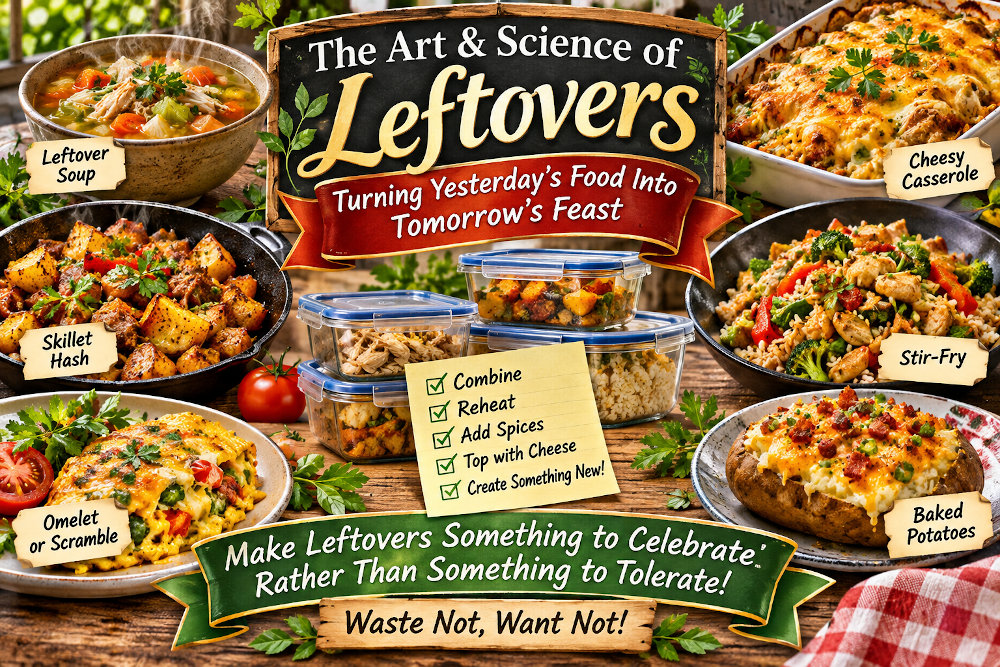
Waste not, want not! The delicious chemistry of giving good food a second life.
Leftovers aren't a specific kind of food. They're ingredients with possibilities!
Let's Celebrate Leftovers!
What if we started thinking of leftovers as something to celebrate rather than something to tolerate?
For many people, the word "leftovers" brings to mind a plate of yesterday's dinner, reheated and served again. Perhaps the same meat, the same potatoes, and the same vegetables. Nothing particularly exciting.
But what if yesterday's dinner was actually the beginning of tomorrow's culinary adventure?
When putting leftovers away, I at times combine them into one casserole dish with in separate sides, then proudly announcing, "Tomorrow's supper is ready to heat!". Over time, the practice caught on.
Amy had a another option, she has made some of the most delicious soups from leftovers! Full of taste!
Leftover pizza, re-baked, often has an enhanced taste, and often a crisper crust!
It's amazing what a little creativity can accomplish.
And there's some fascinating food science behind it all.
1. Why Leftovers Can Taste Better the Next Day
Have you ever noticed that certain soups, stews, chili, and casseroles seem to taste even better the following day?
There's a reason for that, and it involves chemistry.
During cooking, heat breaks down plant cell walls, softens connective tissues, and helps release flavor compounds from vegetables, meats, herbs, and spices.
As a dish cools and rests, some of those compounds continue to move between the liquid and solid ingredients. Seasonings penetrate foods, and flavors can become more evenly distributed.
For example, a pot of vegetable soup may contain onions, carrots, potatoes, celery, tomatoes, herbs, and broth. Initially, some ingredients may have noticeably separate flavors. After resting overnight in the refrigerator, the soup may taste more balanced.
Cooling can also change the texture of starches and fats, influencing how a dish feels and tastes when reheated.
Of course, not every food improves overnight. Crispy fried foods, delicate vegetables, and certain fresh ingredients may lose their original textures.
But for many soups and stews, tomorrow's meal may be worth anticipating!
2. The Art of Combining Leftovers
One of the greatest advantages of leftovers is that much of the cooking has already been done.
Potatoes are cooked. Vegetables are tender. Meat has been seasoned. Rice or pasta is ready.
Instead of simply reheating each item separately, consider what happens when you combine them.
- Leftover roasted vegetables and chicken: Add broth, herbs, and perhaps some rice to create a hearty soup.
- Potatoes, onions, and cooked meat: Chop them together and brown them in a skillet for a delicious hash.
- Rice and assorted vegetables: Add a little oil, garlic, and seasoning for a quick stir-fry.
- Leftover pasta: Combine it with vegetables, tomato sauce, and cheese for a baked casserole.
- Several small portions of vegetables: Add them to a soup, omelet, or savory pie.
What makes this particularly enjoyable is that the combinations don't have to follow a strict recipe.
Cooking becomes an experiment. You observe what you have, imagine what might work together, and make adjustments as you go.
Sometimes the results are ordinary. Other times, you create something so good that you wish you had written down the ingredients!
3. A Little Cheese Changes Everything!
Here's one of my favorite ways to transform leftovers: add a little cheese!
Imagine a mixture of leftover potatoes, vegetables, and meat. It may be perfectly good on its own, but sprinkle some shredded cheddar on top, warm it until the cheese melts, and suddenly you have a different meal.
Cheese contributes several important elements to food:
- Fat: Adds richness and a satisfying mouthfeel.
- Salt: Enhances the perception of other flavors.
- Umami: Provides savory depth, particularly in aged cheeses.
- Protein: Contributes to the structure and texture of melted cheese.
Different cheeses produce different results.
Cheddar can add a sharp, rich flavor. Mozzarella provides a mild taste and a stretchy texture. Parmesan offers concentrated savory flavor, while Swiss cheese can introduce a slightly nutty character.
And here's where the chemistry becomes especially interesting.
When cheese is heated sufficiently, especially on the surface of a casserole or under a broiler, browning reactions can create additional flavor compounds.
One of these processes is the Maillard reaction, a complex interaction between amino compounds and reducing sugars that produces many of the appealing flavors associated with browned foods.
That's part of what makes a golden cheese topping so delicious!
Just remember that a little cheese can go a long way. It adds flavor and nutrients, but also calories, saturated fat, and sodium, depending on the variety.
4. Spice Up Yesterday's Dinner
Another wonderful way to transform leftovers is with herbs and spices.
Have you ever noticed how the same basic ingredients can become completely different dishes depending on the seasonings?
Potatoes and vegetables seasoned with rosemary and thyme may suggest a traditional roasted dinner.
Add cumin, chili powder, and paprika, and the same ingredients take on an entirely different personality.
Garlic, basil, and oregano can create an Italian-inspired dish, while ginger and soy sauce can move the flavors in another direction.
Why does this happen?
Herbs and spices contain aromatic compounds that interact with our senses of smell and taste. Much of what we perceive as flavor actually comes from aroma.
Some flavor compounds dissolve readily in fats, while others are more soluble in water. This helps explain why briefly warming certain spices in oil can release different aromas than simply sprinkling them into a finished dish.
A small amount of acidity, such as lemon juice or vinegar, can also brighten flavors and balance richness.
One caution: leftovers may already contain salt and seasoning, so taste before adding more.
With a little experimentation, yesterday's familiar meal can become something surprisingly new.
5. Reheating Is More Than Making Food Hot
One of the most overlooked aspects of leftovers is how we reheat them.
The microwave, oven, stovetop, and air fryer don't always produce the same results.
And that's because they transfer heat differently.
The Microwave
Microwave ovens use electromagnetic energy to heat food, primarily through interactions with water and other polar molecules.
They are convenient and efficient, but heating can be uneven, especially in thick or irregularly shaped foods.
Covering food, adding a small amount of moisture when appropriate, stirring, and allowing standing time can improve results.
The Stovetop
A skillet is excellent for leftovers that benefit from browning.
Cooked potatoes, vegetables, and meats can develop new flavors when reheated with a little oil over moderate heat.
Unlike ordinary microwave reheating, a hot skillet can dry and brown the surface, encouraging Maillard reactions.
For soups and stews, gentle stovetop heating with occasional stirring helps distribute heat and preserve texture.
The Oven or Air Fryer
Dry circulating heat can help restore crispness to foods that became soft during refrigeration.
Pizza, roasted vegetables, and certain baked dishes often benefit from this method.
The oven is also excellent for creating a lightly browned cheese topping on a casserole.
The key is matching the reheating method to the food and the result you want.
And whatever method you choose, food safety must come first. Leftovers should be heated thoroughly and evenly.
6. Does Cooling and Reheating Change Nutrition?
Here's a particularly fascinating aspect of leftovers: cooling and reheating can change the physical structure of certain foods.
Consider potatoes, rice, and pasta.
When these foods are cooked, starch granules absorb water and undergo a process called gelatinization.
As the cooked food cools, some starch molecules reorganize into structures that are more resistant to digestion.
This process is known as starch retrogradation, and some of the resulting material is called resistant starch.
Resistant starch is not digested in the small intestine in the same way as ordinary digestible starch. Some of it reaches the large intestine, where intestinal microorganisms can ferment it.
Research suggests that cooling certain starchy foods, and sometimes reheating them afterward, can increase their resistant starch content and influence blood glucose responses.
However, the effects vary considerably with the food, preparation method, storage conditions, and individual person.
This doesn't mean that leftover potatoes or rice automatically become low-carbohydrate foods or that everyone will experience the same health benefits.
But it does illustrate an important point: cooking, cooling, and reheating can change food in ways that go beyond flavor.
Some heat-sensitive vitamins may decrease with repeated cooking, particularly when foods are heated for long periods or nutrients are lost in discarded cooking water.
On the other hand, many minerals remain relatively stable, and some cooked foods contain nutrients that are easier for our bodies to access.
So leftovers can still be a nutritious part of a balanced diet.
7. Food Safety: The Important Side of Leftovers
Creativity is wonderful, but leftovers must be handled safely.
Bacteria can multiply when perishable foods remain too long at temperatures between 40°F and 140°F, commonly called the temperature danger zone.
Here are some important practices:
- Refrigerate perishable leftovers within two hours of cooking, or within one hour when temperatures exceed 90°F.
- Keep the refrigerator at 40°F or below.
- Use shallow containers to help large quantities cool more quickly.
- Generally use refrigerated cooked leftovers within three to four days, or freeze them for longer storage.
- Reheat leftovers to an internal temperature of 165°F, checking with a food thermometer.
- Bring leftover soups, sauces, and gravies to a boil when reheating.
- Avoid repeatedly warming an entire batch when you only need one portion.
Cooked rice deserves particular attention because spores of Bacillus cereus can survive cooking and may grow if rice is left at unsafe temperatures. Refrigerate it promptly, and don't assume reheating will eliminate toxins that may have formed.
Remember, food can contain harmful bacteria or toxins without smelling or tasting spoiled.
When in doubt, throw it out.
8. Waste Not, Want Not: An Old Lesson Worth Remembering
Many of us grew up hearing the expression, "Waste not, want not."
It was a simple lesson about appreciating what we had and making good use of it.
Previous generations often approached cooking with a practical understanding that food represented more than what appeared on the dinner plate.
It required land, water, energy, labor, transportation, and money.
Throwing away edible food meant wasting many of those resources as well.
Today, food waste remains a major environmental concern. When discarded food decomposes in landfills under oxygen-poor conditions, it can produce methane, a potent greenhouse gas.
Reducing food waste can therefore help households save money while reducing unnecessary environmental impacts.
And it doesn't require a complicated program.
Sometimes all it takes is opening the refrigerator, looking at what's available, and asking:
"What could I make with this?"
9. Soup: The Great Leftover Transformation
If there were an award for the most versatile leftover meal, soup would certainly be a strong contender!
A little cooked chicken, several vegetables, a few potatoes, some beans, and a bit of broth can become a satisfying meal.
Soup also offers tremendous flexibility.
Too thick? Add a little broth or water.
Not quite enough flavor? Experiment with herbs, spices, or a small amount of acidity.
Need more substance? Add cooked grains, beans, or pasta.
Want something creamy? Puree some of the vegetables or add an appropriate dairy ingredient.
And perhaps best of all, soups often lend themselves to preparing several meals at once.
Amy has created some wonderful soups this way, proving that leftovers don't have to be a compromise.
Sometimes they become the highlight of the week!
10. A Challenge: Create Tomorrow's Feast!
Here's a simple challenge for the next time you open your refrigerator.
Instead of asking which leftovers need to be eaten, ask what new dish they could become.
Could those potatoes become a skillet hash?
Could those vegetables become soup?
Could that leftover chicken become a casserole?
Would a little garlic, paprika, rosemary, or melted cheese bring everything together?
Don't be afraid to experiment, provided the ingredients have been stored safely.
You may discover that your favorite new meal began as several unrelated leftovers.
11. A Fresh Foundation: Leftovers on a Bed of Lettuce
Here's another creative idea from Amy: start with a bed of fresh lettuce, add some leftovers, sprinkle on a little cheese and spices, and finish with a touch of dressing.
Suddenly, yesterday's dinner becomes a fresh, colorful meal!
This approach works with all sorts of ingredients, including cooked chicken, roasted vegetables, beans, potatoes, and other leftovers.
There's even a little food science involved. The crisp lettuce provides a contrast to the softer cooked ingredients. Cheese adds richness, herbs and spices introduce new aromas, and dressing brings the different flavors together.
A dressing containing vinegar or lemon juice can add acidity, helping balance richer ingredients and brighten the overall flavor.
For the best texture, keep the lettuce crisp and add warm ingredients just before serving. Any perishable leftovers should have been stored safely and reheated thoroughly when reheating is needed.
And the best part? You can create something different every time!
Sometimes all it takes to give leftovers a new personality is a fresh foundation.
Final Thoughts
Food is more than fuel. It's chemistry, creativity, tradition, and an opportunity to enjoy something new.
And leftovers are not simply yesterday's meal waiting to be reheated.
They're ingredients waiting for another opportunity.
Sometimes the best meal isn't the one we planned. It's the one we created from what we already had.
So the next time you find yourself staring into the refrigerator, remember:
Make leftovers something to celebrate rather than something to tolerate!
And before you throw away those leftovers, consider what a little imagination, a shake of spices, and perhaps some cheese could do!
Waste not, want not!
Additional Reading
- FoodSafety.gov – Cold Food Storage Guidelines
- USDA – Leftovers and Food Safety
- EPA – Preventing Wasted Food at Home

Exploring Health, Longevity, and Better Living
Zehr.ws